
How Long Does Trademark Registration Take in Zimbabwe?
Trademark registration in Zimbabwe takes 3 to 12 months. Here is what happens at each stage, what causes delays, and why you are protected from day one.
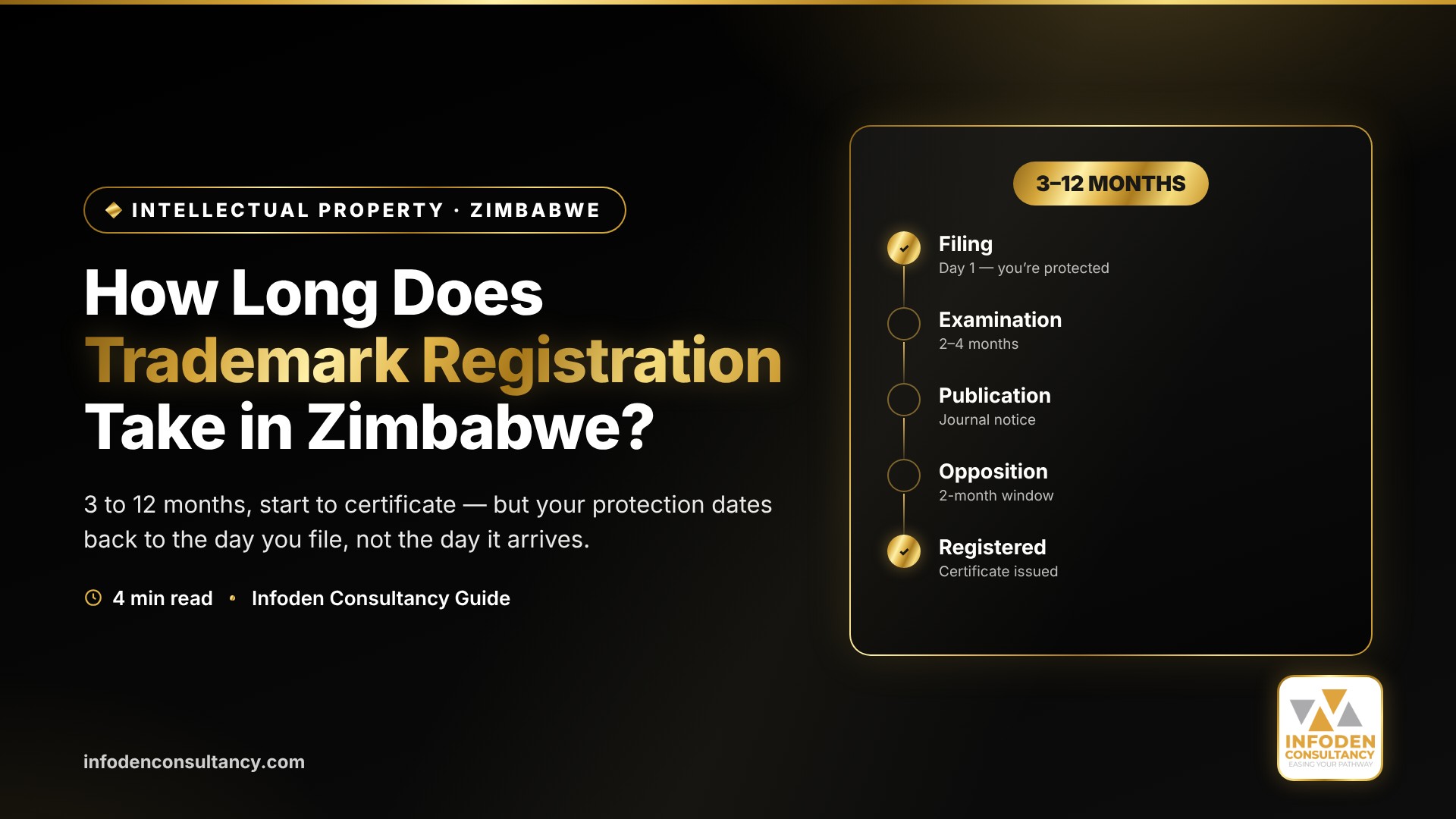
Three to twelve months. That is the honest answer for most applications.
But it is not the answer that matters most, and here is why.
Business owners ask about timing because they are worried about a gap — months of exposure while the paperwork moves and anyone could take the name. That gap does not exist.
Your protection dates back to the day you file. Not the day the certificate arrives.
So the queue is real, but you are already in it, and your place is held from the moment your application lands.
What Happens, and When
| Stage | Typical Timing | What Happens |
|---|---|---|
| Filing | Days | Your application is lodged and dated. This date becomes your priority date. |
| Examination | 2–4 months | The Registrar checks the mark is distinctive and does not clash with existing marks. |
| Publication | After acceptance | Your mark appears in the Zimbabwe Patent and Trade Marks Journal. |
| Opposition window | 2 months | Anyone may object. Most applications pass this quietly. |
| Registration | Weeks after | The certificate is issued, backdated to your filing date. |
Straightforward applications tend to land at the shorter end. Anything that draws a query or an objection moves towards the longer end, or beyond it.
Why the Range Is So Wide
Two applications filed on the same day can finish months apart. The difference is almost always one of these.
How clean the application was. Correct owner details, good artwork, sensible classes and a well-drafted list of goods move through without a query. Anything unclear generates an official action, and every round of correspondence adds weeks.
Whether the Registrar raises an objection. If the mark looks descriptive, or too close to something already registered, you will need to respond with argument and evidence. That is a conversation, not a rejection, but it takes time.
Whether anyone opposes. The two-month window after publication is fixed by law. An actual opposition turns a routine application into a contested one, and the timeline stretches considerably.
How quickly you respond. Deadlines run against you, not the Registry. Applications stall most often because a query sat unanswered in an inbox nobody was watching.
What You Can Do While You Wait
This is the part people do not realise.
Trade normally. Use the name. Build the brand. Open the shop. You are not required to wait for a certificate before using your own mark.
Use ™, not ®. ™ can be used on any mark, registered or not, and signals that you treat it as your brand. Save ® for the day the certificate arrives.
Keep evidence of use. Dated invoices, packaging, adverts, signage photographs. If anyone ever challenges you, this is what proves you were trading and when.
Watch the journal. Your agent should be monitoring publication and the opposition window on your behalf.
Answer queries fast. The single biggest thing within your control.
Being in the Three-Month Group
Nobody can promise a date. But applications that move quickly usually share the same features.
- The owner's exact legal name is correct from the start
- The artwork is clean, original, high quality
- The classes match the actual business
- The goods and services list is specific rather than the whole class copied out
- A search was done first, so no obvious conflicts were sitting there
- The address for service belongs to someone who reads their post
- Every query is answered within days
None of that is luck. It is preparation, and it is done before you file.
Common Mistakes People Make
- Waiting for the certificate before launching. You can trade immediately. Delaying a launch for a piece of paper costs you months of revenue for no legal benefit.
- Using ® during the wait. ® means registered. Using it before the certificate is misleading and can be treated as a false claim.
- Giving an address nobody monitors. Official queries have deadlines. Applications lapse because the letter went somewhere unread.
- Filing a rushed application to "get in the queue". A weak application generates queries, and queries cost more time than careful preparation would have. Speed at filing usually means slowness afterwards.
- Assuming silence means a problem. Long quiet stretches are normal during examination. Ask your agent for a status update rather than worrying.
Expert Perspective
The timeline question usually hides a different anxiety. People are not really asking how long it takes. They are asking whether they are safe in the meantime.
They are — from the filing date. Which reframes the whole thing. If the wait does not expose you, then the only genuinely urgent decision is filing at all. Businesses that delay because "we'll do it when things settle down" are not avoiding a wait. They are leaving the name unclaimed while they build its value.
There is a second point worth making. The wait is useful time if you use it. It is when you should be getting your designer assignment signed, deciding whether to add a second class, working out which export markets are real, and setting up the renewal diary you will need in ten years. Businesses that treat the waiting period as dead time arrive at the certificate with the same gaps they started with.
And a practical note on expectations. Processing times move with resourcing at the Registry. Any timeline is an estimate rather than a promise, and anyone who guarantees you a date is telling you something they cannot control. What can be controlled is the quality of what you file and the speed of your responses — which is most of the difference between three months and twelve.
The Bottom Line
Three to twelve months, depending mostly on how clean the application is and whether anyone objects.
But your rights run from the day you file. So use the name, use ™, keep your evidence, answer queries fast, and get on with the business.
The wait is not the risk. Not filing is.
Ready to file — or already waiting?
Infoden Consultancy prepares applications properly the first time — right owner, right classes, clean artwork, well-drafted specification — which is the main thing standing between a three-month application and a twelve-month one. We also monitor your application and respond to queries on your behalf.
Frequently Asked Questions
How long does trademark registration take in Zimbabwe?
Typically three to twelve months. Clean applications with no objections finish at the shorter end. Objections or oppositions push it longer.
Am I protected while I wait?
Yes. Once registered, your rights are backdated to your filing date, so the waiting period is covered.
Can I use my brand name before registration is complete?
Yes. You can trade normally throughout. Use ™ rather than ® until the certificate is issued.
When can I start using the ® symbol?
Only once your registration certificate has been issued, and only in countries where you are actually registered.
What is the examination stage?
The Registrar checks that your mark is distinctive enough to register and does not clash with marks already on the register. It usually takes two to four months.
What is publication and why does it matter?
Your accepted mark is published in the Zimbabwe Patent and Trade Marks Journal so third parties can see it. This starts the two-month window in which anyone may object.
How long is the opposition period?
Two months from publication. This is fixed and cannot be shortened.
What happens if someone opposes my application?
You respond with a counter-statement and evidence, and the Registrar decides. This adds significant time. Many oppositions settle by agreement on narrowing the goods covered.
What happens if the Registrar raises an objection?
You are given an opportunity to respond with argument or evidence, or to amend your application. It is not an automatic refusal, but each round of correspondence adds weeks.
Can I speed up my application?
Not directly, but you can avoid slowing it down. A clean application, a searched name, correct classes and fast responses to queries make the biggest difference.
Why has my application gone quiet?
Long silences during examination are normal. Ask your agent for a status check rather than assuming something is wrong.
Does the delay affect my ten-year protection period?
No. Your ten years runs from the filing date, so a longer process does not shorten your protection.
Can I register internationally while my Zimbabwean application is pending?
Yes. The WIPO route can be based on a pending Zimbabwean application, not only a completed registration.
What if I need proof of my application before the certificate arrives?
Your filing receipt and application number evidence that you have applied and when. This is often enough for tenders, suppliers or partners who ask.
Action Checklist
Before you file — this is where the timeline is won
- ☐ Search the register first
- ☐ Confirm the exact legal name of the owner
- ☐ Gather clean, original, high-resolution artwork
- ☐ Choose classes that match your actual business
- ☐ Draft a specific goods and services list
- ☐ Give an address for service that someone monitors daily
While you wait
- ☐ Keep trading and building the brand
- ☐ Use ™ on your marks, not ®
- ☐ Keep dated evidence of use: invoices, adverts, packaging, signage
- ☐ Ask for a status update if several months pass in silence
- ☐ Respond to any query within days, not weeks
Use the waiting time well
- ☐ Get written assignments from your designers
- ☐ Decide whether a second class is needed
- ☐ Work out which export markets are actually real
- ☐ Set up your ten-year renewal diary now
When the certificate arrives
- ☐ Switch from ™ to ®
- ☐ File the certificate somewhere findable
- ☐ Confirm the renewal date and diarise it
How Infoden Consultancy Can Help
The timeline is mostly won or lost before you file. Search the register first, get your classes right, and avoid the common mistakes that generate queries and delays. Infoden Consultancy prepares applications properly the first time, quotes costs in writing before any work starts, and monitors your application through to certificate. We also support company registration and ongoing intellectual property management.