What Is a Beneficial Ownership Register, and How Do I File It?
Section 72 of the COBE Act: who counts as a beneficial owner (over 20%), the declaration to the Registrar, the 7-day update rule and the penalties.
Short answer
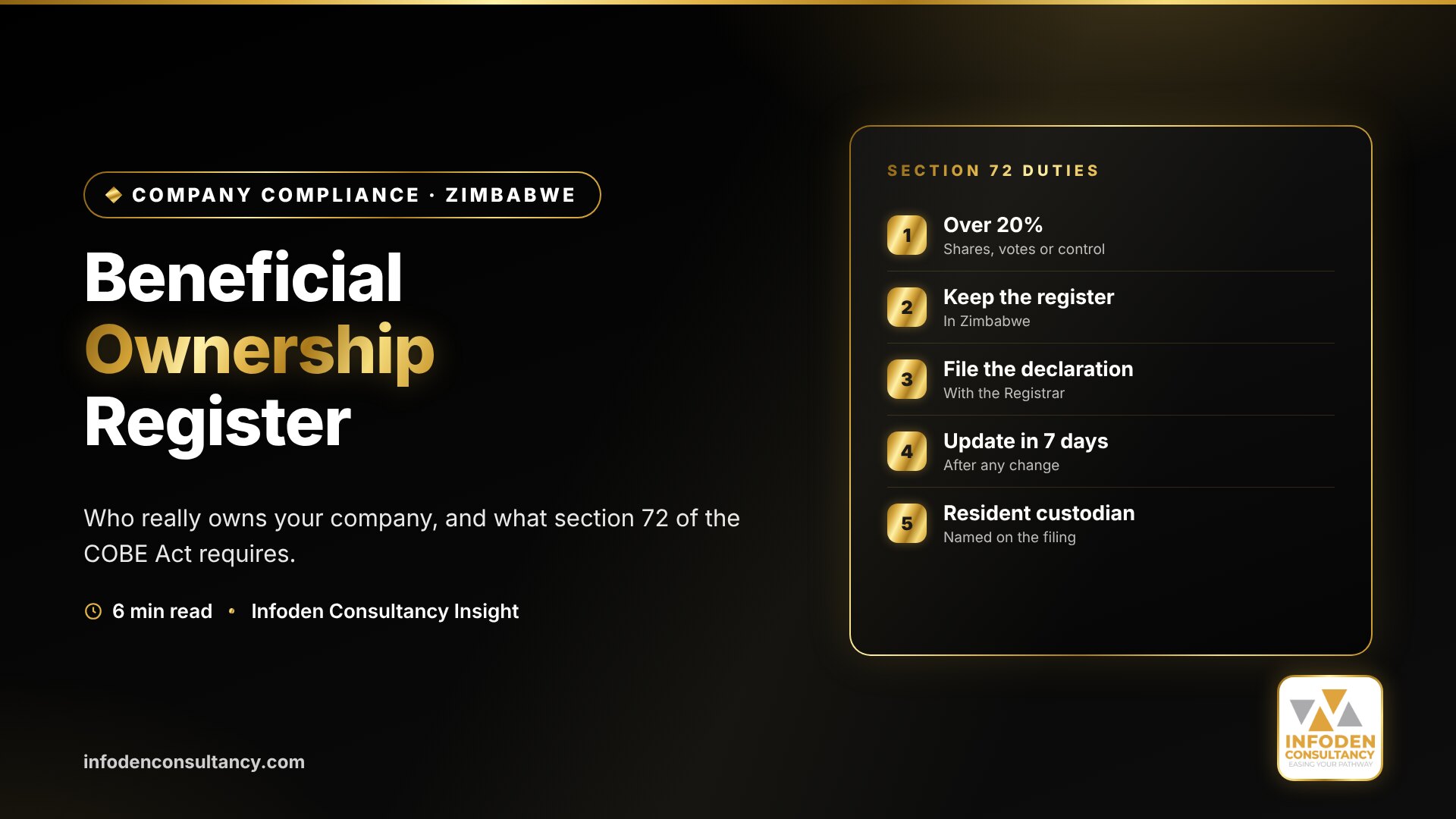
Under section 72 of the COBE Act, every Zimbabwean company must keep a register of its beneficial owners: the real people who own more than 20% or control it. It must file that information with the Registrar in a beneficial ownership declaration, update it within seven days of any change, and appoint a Zimbabwe resident to look after the register.
Your share register shows who owns the shares on paper. The beneficial ownership register shows who is really behind the company, even when shares are held through a nominee, a trust or another company.
Banks increasingly ask for it, and getting it wrong is a criminal offence.
| Key fact | Answer |
|---|---|
| Law | Companies and Other Business Entities Act [Chapter 24:31] (COBE Act), sections 72 and 73 |
| Who must comply | Every company |
| Who counts as a beneficial owner | A natural person who directly or indirectly holds more than 20% of the shares or votes, can appoint or remove most directors, or otherwise has significant influence or control |
| Filing | A beneficial ownership declaration filed with the Registrar of Companies in the prescribed form |
| Updates | Within 7 days of any material change |
| Penalty | A fine up to level 14, up to 5 years’ imprisonment, or both (section 72(10)) |
Who is a beneficial owner?
The COBE Act defines a beneficial owner as a natural person, a human being and never a company, who ultimately owns or controls the company. Specifically, someone who directly or indirectly:
- holds more than 20% of the company’s shares; or
- holds more than 20% of the voting rights; or
- has the right to appoint or remove a majority of the directors; or
- otherwise has, or can exercise, significant influence or control.
Example: Tendai owns 100% of ABC Holdings (Pvt) Ltd, which owns 60% of XYZ Trading (Pvt) Ltd. ABC is the shareholder of XYZ on paper, but Tendai is XYZ’s beneficial owner, because Tendai indirectly holds more than 20%.
What must the company do?
Section 72 sets out the duties:
- Keep the register in Zimbabwe, at the same office as the register of members.
- Record the details. For each director this includes full names, any former names, ID number, residential or business address, postal address, nationality, and the nature and extent of their beneficial ownership.
- File with the Registrar accurate, up-to-date beneficial ownership information in the prescribed form: the beneficial ownership declaration.
- Update within seven days whenever there is a material change, such as a share sale, a new investor or a change of control.
- Appoint a resident custodian. The company must appoint a person resident in Zimbabwe to keep the register and give it to the Financial Intelligence Unit (FIU) or law enforcement on request. Their name and contact details go on the form you file.
- Keep the records for five years after the company is dissolved.
Why are banks asking for it?
Because the law lets them. Section 72(6) makes beneficial ownership information held by the Registrar public information, open to inspection by the public and specifically by financial institutions and other bodies covered by the Money Laundering and Proceeds of Crime Act.
When a bank opens or reviews a business account, it must know who really owns and controls the business. A filed, up-to-date declaration makes that quick. A missing or outdated one can stall the account.
What about nominee shareholders?
Section 73 forbids hiding beneficial ownership. A nominee holding shares for someone else must disclose the real owner to the company, so that the company can record them under section 72. The real owner can ask not to appear on the face of the share certificate, but they must still be on the beneficial ownership register.
Common mistakes
- Listing a company as the beneficial owner. The law asks for the natural person at the top of the chain.
- Forgetting the seven-day update. A share transfer without a beneficial ownership update leaves the filing wrong, and that is an offence.
- No resident custodian. Diaspora-owned companies often forget to name someone in Zimbabwe.
- Hiding behind a nominee. Concealment is exactly what sections 72 and 73 target.
Frequently asked questions
Is the beneficial ownership declaration the same as the CR6 or CR14?
No. The CR6 (or CR14 on older companies) lists directors and secretaries, and the share register shows legal shareholders. The beneficial ownership declaration records the real people who own or control the company, which can be different.
Does a one-person company need a beneficial ownership register?
Yes. Every company must keep one. If you own all the shares yourself, the register is simple: it names you. It still has to be kept, filed and updated.
Can members of the public see who owns my company?
Yes, from the Registrar’s records. Section 72(6) says beneficial ownership information held by the Registrar is public and open to inspection, subject to the nominee rule in section 73(10).
Do PBCs have the same obligation?
Section 72 is written for companies, and section 73 extends the nominee disclosure rules to private business corporations as well. If you run a PBC, keep your members’ details accurate and ask Infoden about any nominee arrangement.
What to do next
Write down every person who holds more than 20%, directly or through another entity, and check that your filed declaration matches.
If it doesn’t, or you have never filed one, Infoden can prepare and file it with your other company secretarial returns through our compliance services.
Is your beneficial ownership filing up to date?
Send us your company name and we’ll check what is on record.
Sources and law
- Companies and Other Business Entities Act [Chapter 24:31], section 2 (definition of beneficial owner), sections 72 and 73, via Veritas. Checked 22 November 2026.
- FIU Zimbabwe: Legal Persons and Legal Arrangements National Risk Assessment (2024).
This is general information, not legal or tax advice for your specific situation. Contact Infoden for advice on your situation.