ZIDA Registration in Zimbabwe: Costs, Steps and Pitfalls
ZIDA registration explained: the real cost of a General Investment Licence, the full document list, renewal traps, and how to avoid a rejected application.
An investor we spoke to last year had done everything right, or so he thought. Company registered. Bank account opened. Warehouse identified in Msasa. He paid the ZIDA application fee, waited, and got the news he wanted — approved.
Then came the invoice for the licence fee. USD 4,620, payable before the licence would be issued.
He hadn't budgeted for it. Not because anyone hid it from him, but because he'd assumed the application fee was the fee. Three weeks of scrambling followed, at exactly the moment he should have been moving equipment.
That gap — between what people assume ZIDA registration costs and what it actually costs — causes more delays than any bureaucratic hold-up we see. And the money is only the first thing investors get wrong.
Why ZIDA Registration Matters More Than People Think
The Zimbabwe Investment and Development Agency was created under the ZIDA Act [Chapter 14:37] of 2019, folding what used to be three separate bodies into one. The idea was simple: give investors a single front door instead of a scavenger hunt across ministries.
Here's the part that surprises people. Nothing in the law says every business in Zimbabwe must hold an investment licence. You can register a company and trade without one.
So why bother?
Because the licence is what activates the protections and facilitation the Act offers. It's formal state recognition that your investment is genuine, which matters enormously when you later need something from someone else — a work permit for a technical director, a mining or tourism permit, duty relief on imported plant, or a bank willing to process the repatriation of your dividends.
That last point deserves emphasis. When a foreign investor eventually wants to take profits or capital out of Zimbabwe, the questions asked are about how the money came in. An investment licence, sitting alongside your forex declarations and bank confirmations, is the document that makes that conversation short instead of long. Investors who skip the licence at the start often discover this three years later, when it's expensive to fix.
The Act also directs state bodies to give priority to applications from licensed investors. In practice, a ZIDA licence is a queue-jumping instrument. That's worth real money in time saved.
What a General Investment Licence Actually Covers
The General Investment (GI) Licence is the standard route for private capital deployed outside a Special Economic Zone and outside a public-private partnership structure. You decide independently where your money goes — manufacturing, agriculture, property, services, a startup — with no requirement to partner with a government entity.
If your project sits inside a designated SEZ, or involves government as a contractual partner, you're on a different track with different regulations. Worth confirming before you fill in a single form.
The Real Cost of ZIDA Registration
Let's put the numbers on the table, because vagueness here helps nobody.
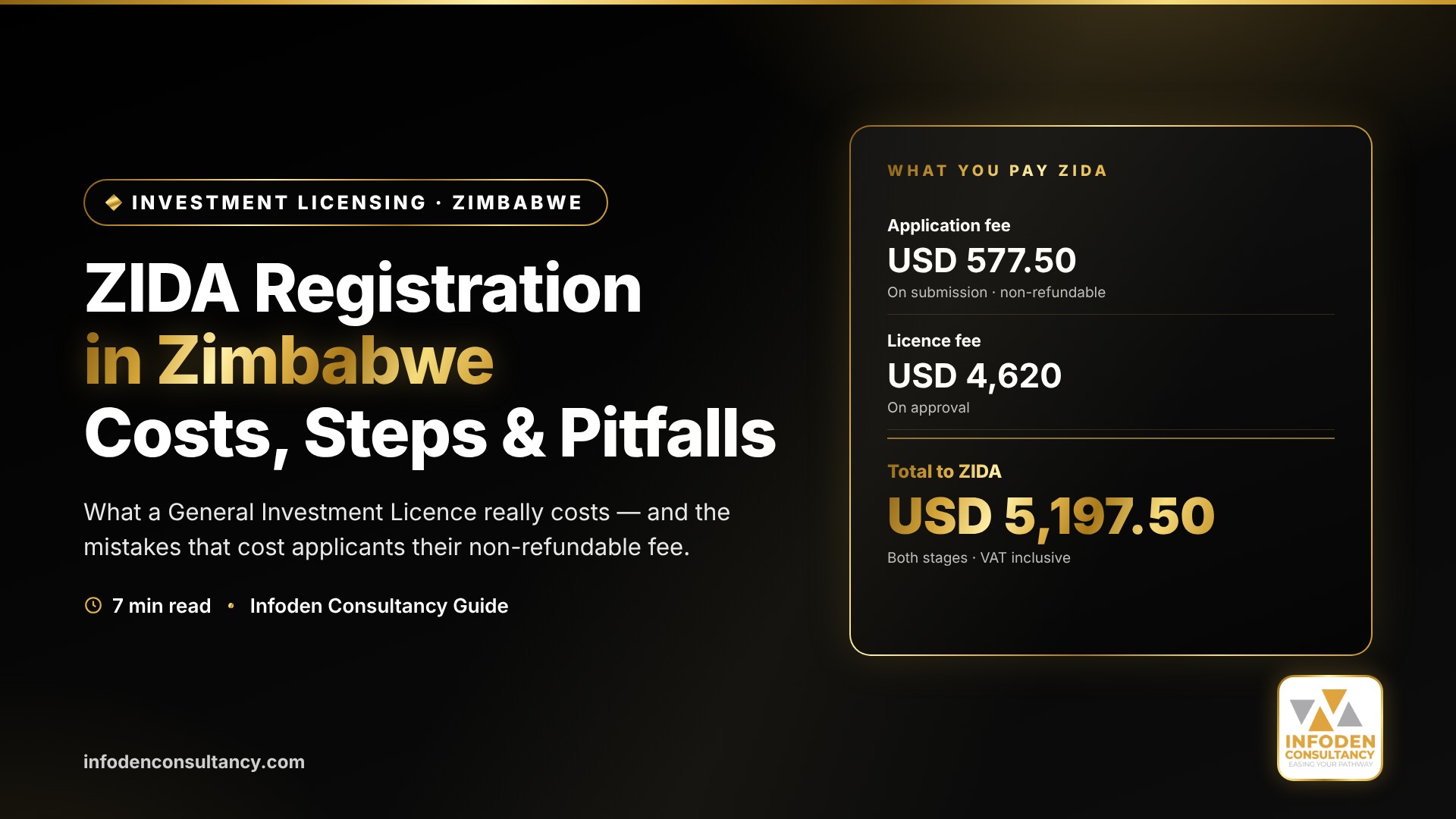
| Payment | Excl. VAT | Incl. VAT | When it falls due |
|---|---|---|---|
| Application fee (non-refundable) | USD 500 | USD 577.50 | On submission |
| Licence fee | USD 4,000 | USD 4,620 | On approval |
| Total payable to ZIDA | USD 4,500 | USD 5,197.50 |
Three things to sit with.
The application fee is non-refundable. A weak application doesn't get a refund and a second chance for free. It gets a rejection and a fresh USD 577.50 to try again. This is precisely why cheap, careless applications turn out to be the expensive option.
The licence fee lands on approval, not before. Good news for cashflow, bad news for anyone who budgeted only for stage one.
Infoden's professional fee is USD 1,000. That covers preparing and lodging the application properly, structuring the supporting documents so they hold together, and dealing with queries. Budget roughly USD 6,200 all-in.
What You Need to Submit
The core document set for a GI Licence:
- Proof of payment of the USD 577.50 application fee
- A fully completed ZIDA 1 Application Form
- Company registration documents, including the Memorandum and Articles of Association
- An official list of shareholders and/or directors
- A power of attorney, where an agent or representative applies on the investor's behalf
That list looks short. It isn't, once you understand what sits behind it.
Your shareholder and director list must reconcile exactly with what the Companies Registry holds. Your Memorandum's objects clause must actually permit the activity you're describing. If your form says agro-processing and your objects clause says property holding, someone will notice — and it will not be at a convenient moment. We've reviewed applications where the objects clause described a completely different business, inherited from a shelf company nobody read.
Applications are now electronic, so an investor abroad doesn't need to travel to Zimbabwe: Infoden lodges the application for you. It also means scanned documents get read carefully, and a blurry certified copy is a delay.
Common Mistakes People Make
1. Budgeting for the application fee only.
The USD 4,620 on approval catches people who read the first line of the fee schedule and stopped. Consequence: your licence sits unissued while you raise money. Fix: treat USD 5,197.50 as the number from day one.
2. Applying before the company file is clean.
Mismatched shareholding, an unamended objects clause, missing CR forms. Consequence: queries, resubmission, sometimes a lost application fee. Fix: audit the company file before you touch the ZIDA 1.
3. Writing investment projections you can't evidence later.
It's tempting to state a big number to look serious. But renewal requires a progress report comparing actual investment against your original projection, plus bank statements and jobs created. Consequence: a licensed investor who delivered 20% of what they promised has an awkward renewal. Fix: project what you can defend.
4. Omitting the power of attorney.
If a consultant, lawyer, or local director is applying for you, ZIDA needs written authority. Consequence: the file stalls before assessment. Fix: prepare it at the same time as the ZIDA 1, properly notarised where the investor signs offshore.
5. Assuming the licence replaces everything else.
It doesn't. You'll still need ZIMRA registration, NSSA, a local authority licence where applicable, an EIA certificate for certain projects, and any sector permit your industry demands. Consequence: an investor with a valid licence, unable to legally operate. Fix: map the full permit stack at the outset.
6. Missing the renewal window.
Renewal applications must be lodged at least three months before expiry. There is a limited grace period after expiry, but if the licence is terminated for want of renewal, you start over with a fresh application. Consequence: paying full fees twice. Fix: diarise the renewal date the day the licence is issued.
7. Changing shareholders quietly.
A licence isn't transferable without ZIDA's prior approval, and shareholding changes require a formal amendment, supported by a CR2 and a Capital Gains Tax certificate. Consequence: a licence that no longer matches reality, discovered at the worst time — during due diligence for your next funding round.
Expert Perspective
Zimbabwe's investment framework tightened considerably with the General Investments Regulations of 2023, which sit under the ZIDA Act alongside separate SEZ regulations. Two developments deserve an investor's attention.
The first is the formal distinction between investor licensing and investor registration. Registration is available to projects already established without ZIDA's involvement. If you've been operating in Zimbabwe for years without a licence, there's a route in — and there are good reasons to take it before you next need something from government.
The second is the Investor Grievance Response Mechanism, designed to resolve early-stage investor complaints before they become disputes. It's an underused channel. Investors reach for lawyers when a phone call to the right unit would have done the job.
Strategically, the mistake we see most often among sophisticated investors is treating the licence as a compliance formality rather than a live record. It isn't. It states your project, your location, your activity, your capital. The law obliges you to notify ZIDA if you can't implement the investment as described, and a licence obtained through misrepresentation can be cancelled. The register of licences is public.
So the licence you hold is, in effect, a public commitment. Treat renewal as a performance review, because that's what it is — progress against projection, jobs created against jobs promised, tax and NSSA compliance current. Investors who keep tidy records find renewal routine. Investors who don't find it a reconstruction exercise across three years of missing paperwork.
One last observation, from watching this play out repeatedly: the licence is most valuable to investors who need something from the state later. If your project involves work permits for expatriate staff, imported capital equipment, land, or any regulated sector, the licence pays for itself in reduced friction. If you're a small local service business with none of those needs, be honest with yourself about whether USD 5,197.50 is your best use of capital this year. A good adviser will tell you when the answer is no.
The Bottom Line
ZIDA registration isn't complicated. It's just unforgiving of sloppiness.
Get three things right and the process is straightforward: budget the full USD 5,197.50 from the start, make sure your company documents tell one consistent story, and write projections you'll still be comfortable with at renewal. Get those wrong and you'll pay the application fee more than once.
The licence itself does real work — recognition, protection, faster permits, a cleaner path for capital and dividends. But it works best for investors who treat it as a living obligation rather than a certificate for the wall.
Thinking about applying?
Infoden Consultancy handles ZIDA applications end to end — reviewing your company file before submission, preparing the ZIDA 1 and supporting pack, and managing queries through to issue. Our professional fee is USD 1,000, separate from ZIDA's statutory fees. Send us your company documents and a short description of what you're planning, and we'll tell you what's missing before you spend anything.
Frequently Asked Questions
Is ZIDA registration compulsory in Zimbabwe?
No. You can register a company and trade without an investment licence. However, the licence is what gives you access to the protections and facilitation under the ZIDA Act, and it's effectively expected of foreign investors seeking permits, incentives, or a clean path for repatriating capital.
How much does ZIDA registration cost?
USD 5,197.50 payable to ZIDA in total — USD 577.50 non-refundable on application and USD 4,620 on approval, both VAT-inclusive. Infoden's professional fee is USD 1,000.
Is the application fee refundable if I'm rejected?
No. The USD 577.50 is non-refundable regardless of outcome, which is the strongest argument for getting the application right first time.
Can a foreign investor apply without travelling to Zimbabwe?
Yes. Infoden lodges the application with ZIDA on the investor's behalf, with a signed power of attorney.
What is a General Investment Licence?
It's the licence for private investment made outside a Special Economic Zone and without a mandatory government partnership. The investor independently chooses where to deploy capital.
How long does ZIDA registration take?
Timelines vary with the quality of the submission and the complexity of the project. Clean applications with reconciled company documents move considerably faster than files that generate queries. Build the licence fee payment into your timeline as well.
Do I need to register my company before applying?
Yes. Company registration documents, including the Memorandum and Articles of Association, and an official list of shareholders and directors form part of the application.
What is the ZIDA 1 form?
It's the prescribed application form for a General Investment Licence, downloadable from ZIDA and submitted with the supporting document pack.
When do I need a power of attorney?
Whenever the application is made by an agent or representative rather than the investor personally. Where the investor signs outside Zimbabwe, have it notarised.
What's required to renew a GI Licence?
An application letter to the Chief Executive Officer, a detailed progress report on actual investment, activity, and jobs against projections, three months of bank statements, an employee list, two years of financial statements plus two years of projections, a completed Investment Update Report, and statutory compliance documents — tax clearance, NSSA clearance, and any factory, sector, or EIA certificate that applies.
When must I apply for renewal?
At least three months before the licence expires. A late application may be considered within a limited grace period after expiry, but a licence terminated for want of renewal requires a fresh application at full cost.
How do I change shareholders or company details on my licence?
Through a formal amendment application, supported by a board resolution, a CR2 and Capital Gains Tax certificate for shareholding changes, resignation confirmations from outgoing shareholders, proof of funds from incoming shareholders, and certified identity or incorporation documents.
Does the licence cover all the permits I need?
No. ZIMRA registration, NSSA, local authority licences, EIA certificates, and sector permits remain separate — though the licence helps you obtain them through the one-stop service framework.
Can my licence be cancelled?
Yes, including where it was obtained through misrepresentation or false statements. You're also obliged to notify ZIDA if you become unable to implement the investment as described.
What if I've been operating for years without a licence?
There's an investor registration route for projects established without ZIDA's involvement. It's worth regularising before you next need something from a government agency.
Action Checklist
Before you apply
- ☐ Confirm your project sits outside an SEZ and involves no mandatory government partnership
- ☐ Confirm the company is registered and the registry file is current
- ☐ Check the Memorandum's objects clause permits your actual intended activity
- ☐ Reconcile your shareholder and director list against Companies Registry records
- ☐ Confirm you have USD 5,197.50 available across both payment stages
- ☐ Decide whether an agent will apply on your behalf
Assembling the pack
- ☐ Pay the USD 577.50 application fee and keep proof
- ☐ Complete the ZIDA 1 Application Form in full
- ☐ Attach the Memorandum and Articles of Association
- ☐ Attach the official list of shareholders and/or directors
- ☐ Prepare and notarise the power of attorney, if using an agent
- ☐ Prepare investment projections you can evidence in two to three years
- ☐ Check every scanned document is legible and properly certified
After approval
- ☐ Pay the USD 4,620 licence fee
- ☐ Diarise the renewal date, with a reminder four months ahead
- ☐ Complete ZIMRA and NSSA registration
- ☐ Obtain your local authority licence, sector permit, and EIA certificate where applicable
- ☐ Set up a file for renewal evidence: bank statements, forex declarations, bills of entry, employee records
- ☐ Notify ZIDA before making any shareholding or structural change
How Infoden Consultancy Can Help
Most ZIDA applications are won or lost before submission. We review the company file first — shareholding, objects clause, CR forms — then prepare the ZIDA 1 and supporting pack, and handle queries through to issue. If you still need to register a company in Zimbabwe, sort out ZIMRA tax registration and NSSA registration, or keep ongoing compliance tidy for renewal, we handle those too.