How Small Businesses Can Become Tender Ready in Zimbabwe: The Complete Guide to Winning More Business
How Small Businesses Can Become Tender Ready in Zimbabwe: The Complete Guide to Winning More BusinessMeta Description: Learn how to make your small busines...

How Small Businesses Can Become Tender Ready in Zimbabwe: The Complete Guide to Winning More Business
Meta Description: Learn how to make your small business tender ready in Zimbabwe. Discover the essential legal, financial, and compliance requirements to qualify for government and corporate tenders.
How Small Businesses Can Become Tender Ready in Zimbabwe: The Complete Guide to Winning More Business
You finally find the perfect tender opportunity.
The contract is worth US$250,000. Your business has the skills, the team, and the capacity to deliver. You're excited because this could be the breakthrough your company has been waiting for.
Then you start reading the tender requirements.
You need a valid Tax Clearance Certificate.
Your company must be registered with the Procurement Regulatory Authority of Zimbabwe (PRAZ).
You need audited or professionally prepared financial statements.
Your company profile is outdated.
Some statutory documents have expired.
Before you've even started preparing your bid, you realise something frustrating: your business isn't tender ready.
This is a reality for thousands of small and medium-sized enterprises (SMEs) across Zimbabwe. Every year, businesses miss out on valuable contracts—not because they lack expertise or competitive pricing, but because they haven't prepared their businesses to meet procurement requirements.
The good news is that becoming tender ready isn't complicated. It requires planning, organisation, and a commitment to keeping your business compliant.
Whether you're targeting government tenders, local authorities, NGOs, state-owned enterprises, or private companies, this guide explains exactly what it means to become tender ready and the practical steps you can take to position your business for success.
What Does "Tender Ready" Mean?
A tender-ready business has the legal, financial, operational, and administrative systems needed to compete confidently for procurement opportunities.
Being tender ready doesn't guarantee that you'll win every contract. It does, however, ensure that when opportunities arise, your business can submit a complete, credible, and competitive bid without scrambling to gather missing documents.
Tender readiness demonstrates professionalism. It tells procurement officers that your business is organised, compliant, and capable of delivering what it promises.
Many procurement processes include mandatory compliance requirements. Failure to meet even one of these requirements may result in your bid being rejected before your pricing or technical proposal is even considered.
Why Tender Readiness Matters
Winning a tender can change the future of a business.
For many SMEs, a single contract can:
Increase annual revenue significantly.
Create new employment opportunities.
Improve cash flow.
Build credibility in the market.
Open doors to larger contracts.
Strengthen relationships with government and corporate buyers.
On the other hand, businesses that are not prepared often face repeated disappointment. They spend valuable time downloading tender documents only to discover they cannot meet the basic eligibility requirements.
Tender readiness is about being proactive instead of reactive.
Who Should Become Tender Ready?
Tender readiness isn't only for large companies.
In fact, some of the biggest opportunities today are specifically designed to encourage SME participation.
Your business should become tender ready if you provide products or services such as:
Construction and civil works
Information technology services
Office supplies and stationery
Cleaning services
Security services
Transport and logistics
Printing and branding
Consultancy services
Engineering services
Medical supplies
Agricultural products
Catering services
Furniture supply
Electrical installations
General supplies
Even if you have no immediate plans to bid for tenders, preparing your business now ensures you're ready when the right opportunity comes along.
Step 1: Register Your Business Properly
The first step towards becoming tender ready is ensuring your business is legally recognised.
Many procurement entities require bidders to be registered businesses. Operating informally may limit your ability to compete for larger contracts.
Depending on your business structure, this may involve registering:
A Private Limited Company
A Private Business Corporation (PBC)
A Trust or other recognised legal entity where appropriate
A properly registered business demonstrates credibility and provides confidence to prospective clients.
Why this matters
Imagine two businesses submitting identical proposals.
One is formally registered, has clear ownership records, and complies with statutory requirements.
The other operates informally without proper documentation.
Most procurement committees will naturally favour the business that presents less legal and operational risk.
Step 2: Obtain Tax Registration and Maintain Compliance
One of the quickest ways to disqualify your business from a tender is failing to meet tax compliance requirements.
Most government departments, parastatals, local authorities, and many private companies require bidders to have valid tax records.
This typically includes:
Business tax registration
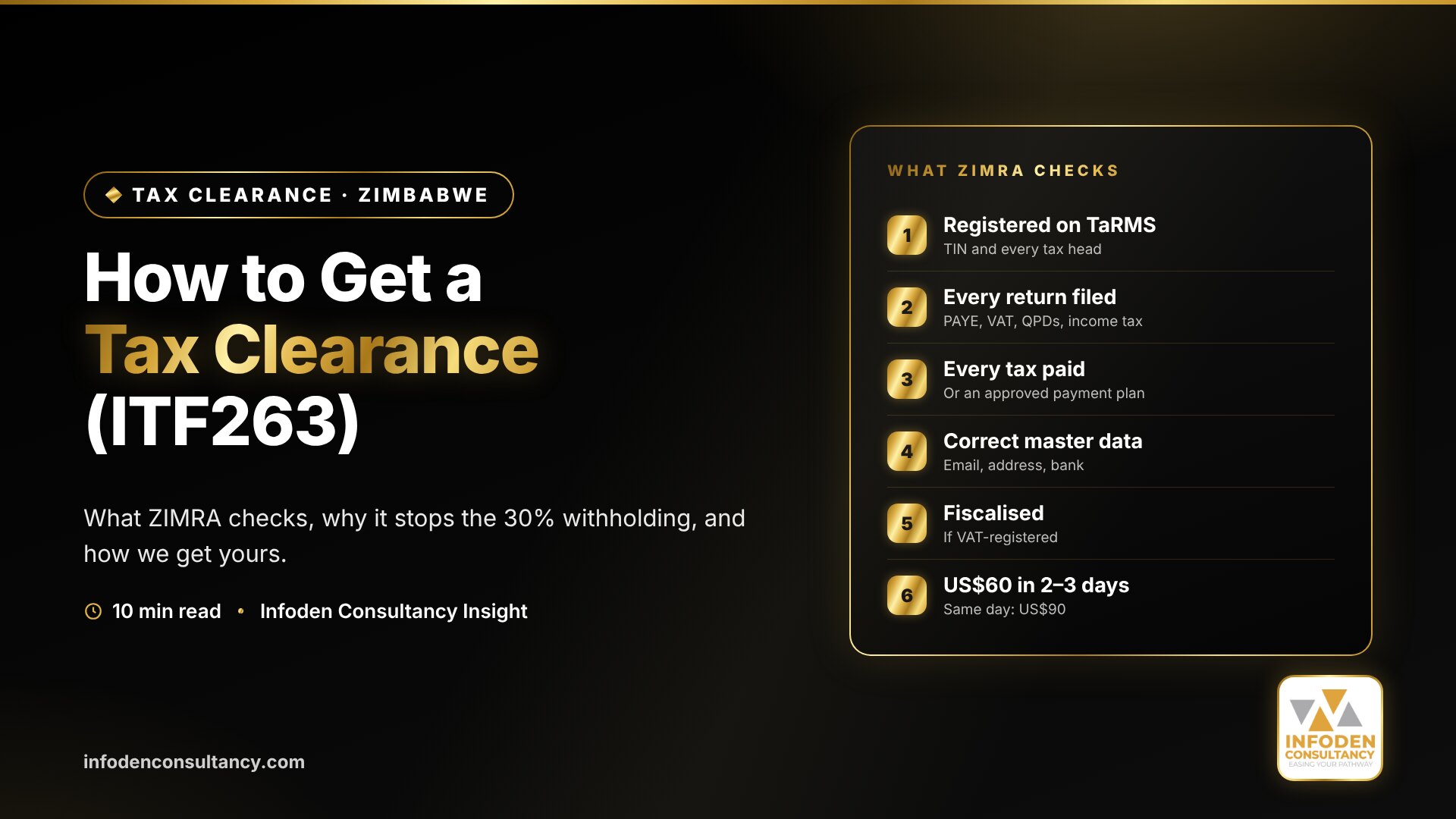
A valid Tax Clearance Certificate (ITF263)
VAT registration where applicable
Up-to-date tax compliance
Tax compliance demonstrates that your business operates responsibly and fulfils its statutory obligations.
It also gives procurement officers confidence that they are dealing with a legitimate business.
Waiting until a tender is advertised to resolve tax issues often leads to missed deadlines.
The most successful businesses maintain compliance throughout the year rather than only when opportunities arise.
Step 3: Register with PRAZ
If you intend to compete for public procurement opportunities in Zimbabwe, registering with the Procurement Regulatory Authority of Zimbabwe (PRAZ) is one of the most important steps you can take.
PRAZ registration enables your business to participate in public procurement opportunities and demonstrates that your business has taken procurement compliance seriously.
While registration requirements may vary depending on your industry and procurement category, completing this process well in advance prevents unnecessary delays when tenders are announced.
Businesses that postpone PRAZ registration often find themselves rushing to complete documentation after tender notices have already been published.
By then, valuable preparation time has already been lost.
Step 4: Build a Professional Company Profile
Your company profile is often the first impression evaluators have of your business.
A weak company profile can undermine an otherwise excellent proposal.
An effective company profile should clearly explain:
Your business overview.
Your mission and vision.
Products and services.
Experience.
Key personnel.
Equipment and resources.
Previous projects.
Certifications.
Contact information.
Remember, procurement committees don't know your business.
Your company profile should answer the question:
"Why should we trust this company to deliver?"
A professionally designed profile builds confidence before evaluators even reach your pricing schedule.
Step 5: Keep Your Business Records Organised
One of the biggest differences between businesses that consistently win tenders and those that struggle is documentation.
Successful businesses maintain an organised library of important documents that can be updated as needed.
This typically includes:
Company registration documents
Tax certificates
Shareholding information
Director details
Proof of address
Bank confirmation letters
Financial statements
Insurance certificates
Professional licences
Previous contract references
Instead of searching through files whenever a tender is advertised, tender-ready businesses can respond quickly because everything is already in place.
Frequently Asked Questions
How can Infoden help my business?
Infoden Consultancy provides end-to-end business services including company registration, tax compliance, trademark registration, and corporate secretarial services across Zimbabwe, South Africa and Dubai. Since 2022 it has registered 500+ companies; a Zimbabwe Private Limited company is USD 120, a PBC USD 100 and a South Africa Pty Ltd USD 100.
How long does it take to register a company?
Company registration typically takes 3-5 working days with Infoden handling all documentation and filing with the Registrar of Companies.
What countries does Infoden operate in?
Infoden registers companies in Zimbabwe, South Africa and the UAE (Dubai free zones), and handles tax and compliance for them.