Why Do Clients Withhold 30% Tax, and How Does an ITF263 Stop It?
Without a valid ITF263, clients must withhold 30% of each payment under section 80 of the Income Tax Act. Not 10%. How it works and how to stop it.

Short answer
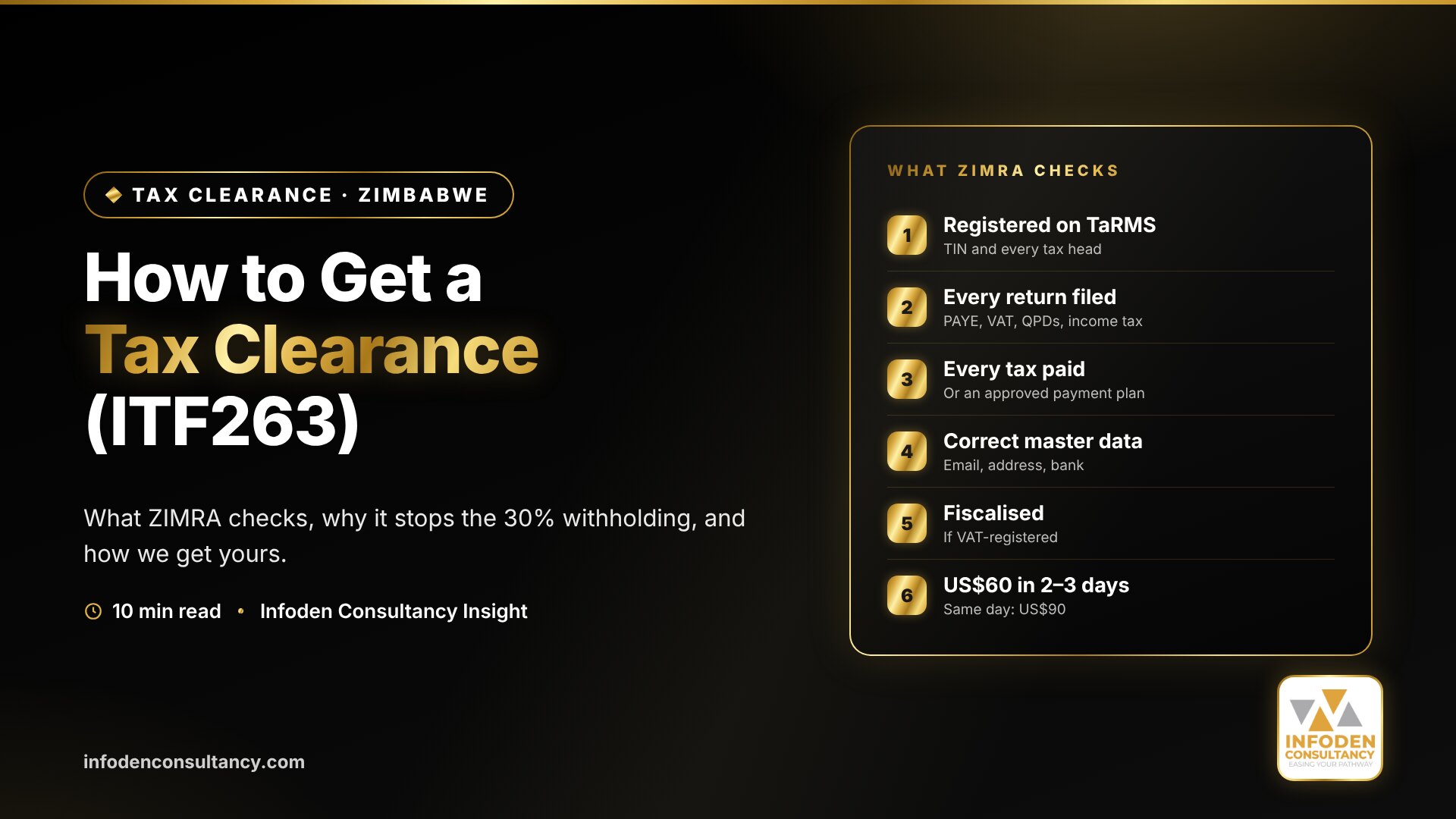
If you can’t show a valid tax clearance certificate (ITF263), section 80 of Zimbabwe’s Income Tax Act requires the business paying you to withhold 30% of each payment and send it to ZIMRA. The rate rose from 10% to 30% on 1 January 2022. Give your client a valid ITF263 and they pay you in full.
You deliver the goods, send the invoice for US$10,000, and only US$7,000 lands in your account. Your client isn’t being difficult. The law makes them do it, and if they don’t, ZIMRA can make them pay the missing tax.
Many people still talk about a “10% withholding tax”. That rate ended in 2021. Here is how the rule works today.
| Key fact | Answer |
|---|---|
| Law | Income Tax Act [Chapter 23:06], section 80 |
| Rate | 30% of the amount payable (10% before 1 January 2022) |
| When it applies | The supplier doesn’t give the payer a valid tax clearance certificate (ITF263) |
| Threshold | Payments to one supplier adding up to US$1,000 or more in a year of assessment |
| Payer sends it to ZIMRA | By the 10th of the month after the payment, with a schedule of suppliers |
| Supplier gets | A certificate showing the amount withheld, which counts as a credit against the supplier’s income tax |
Why is my client deducting 30% from my invoice?
Because they don’t have a valid ITF263 from you. Section 80 of the Income Tax Act says that when a registered business pays a supplier under a contract and the supplier doesn’t hand over a valid tax clearance, the payer must keep back part of the payment and send it to ZIMRA.
ZIMRA calls this “withholding tax on tenders”, but it reaches much further than government tenders. It applies to ordinary business-to-business contracts too.
Is it 10% or 30%?
It is 30%. ZIMRA announced that the rate went up from 10% to 30% with effect from 1 January 2022. At the same time the threshold moved to US$1,000 (or ZWL$130,000 then) in total payments during the year of assessment.
So once your invoices to one client add up to US$1,000 in a year, every payment without a clearance attracts the 30%.
What happens to the 30% they keep?
It isn’t lost, but it is tied up until your tax is assessed. ZIMRA’s guidance says:
- The payer must give you a certificate showing how much was withheld.
- The payer sends the money to ZIMRA by the 10th of the following month, in the currency of the purchase, with a schedule naming each supplier.
- ZIMRA holds it until your income tax for the year is assessed.
- The amount is then allowed as a credit against the income tax you owe.
For a small business, that is still a cash-flow problem. Thirty cents of every dollar sits with ZIMRA for months, and you only get the benefit if your own returns are in order. Keep every withholding certificate your clients give you.
How does an ITF263 stop the deduction?
Give the paying business a copy of your valid ITF263 before they pay. ZIMRA lists “no 30% withholding tax” as the first benefit of having one.
Watch the dates. In 2026 certificates last for a shorter period than before, so a copy you sent at the start of the year may have expired by the time the client pays. Send the current one with each invoice.
Many payers will also check that your certificate is genuine on ZIMRA’s verification service. A fake clearance doesn’t protect them, so they won’t accept one. Our ITF263 guide explains how clearances are issued and checked.
I pay suppliers. What are my duties?
If you are a registered business paying suppliers, the rule also binds you:
- Ask every supplier for a valid ITF263 and check it.
- If they don’t have one, and payments to them reach US$1,000 in the year, withhold 30%.
- Give the supplier a certificate of the amount withheld.
- Pay it over to ZIMRA by the 10th of the next month, with the supplier schedule.
ZIMRA is clear that a payer who fails to withhold or pay over becomes liable for the tax themselves. You would be paying your supplier’s tax out of your own pocket.
When doesn’t the 30% apply?
ZIMRA lists two main exceptions:
- Payments agreed to settle a delictual claim against the State or a statutory corporation.
- Ordinary shop sales and other consumer sales where the buyer is the final user. This exception doesn’t cover contracts for the sale, letting or hire of immovable property.
Common mistakes
- Quoting the old 10% rate. Pricing a contract on 10% when 30% will be withheld can wipe out your margin.
- Sending an expired clearance. The client withholds, and you can’t get the money back from them. Check the validity dates on every copy you send.
- Losing the withholding certificates. Without them, claiming the credit against your income tax becomes much harder.
- Payers trusting a photocopy. Verify the certificate with ZIMRA, or the tax can come back to you.
Frequently asked questions
Can I get the 30% back from ZIMRA?
It counts as a credit against your income tax for that year once you are assessed. If the credit is more than the tax you owe, the difference is dealt with through ZIMRA’s refund or offset process, which Infoden handles for clients. You need the withholding certificates and up-to-date returns.
Does the 30% apply to government tenders only?
No. Section 80 applies to registered businesses paying under contracts, as well as to the State and statutory corporations. Private companies must withhold too.
Can my client refuse to withhold if I promise to get my clearance later?
Not safely. If they pay in full without a valid ITF263 and the threshold is reached, ZIMRA can hold them liable for the 30%. The only sure fix is a valid certificate before payment.
Does the 30% withholding apply to non-resident suppliers?
Payments to non-residents fall under separate non-resident tax rules, not this section 80 withholding. Ask Infoden which rule applies before you pay a foreign supplier.
What to do next
Check today whether you have a valid ITF263, and attach it to every invoice you send.
If you don’t have one, Infoden finds out what is blocking it, gets your business compliant with ZIMRA and gets your ITF263 issued in 2–3 days for US$60, all fees included, or the same day for US$90. See our tax services.
Losing 30% on every invoice?
Message us and we’ll work out what stands between you and a valid tax clearance.
Sources and law
- ZIMRA: Withholding tax on tenders (30% from 1 January 2022, threshold, remittance by the 10th, credit, exceptions). Checked 22 November 2026.
- ZIMRA: Authentication of a tax clearance (payer liability, verification). Checked 22 November 2026.
- ZIMRA: What is an ITF263? Checked 22 November 2026.
- Income Tax Act [Chapter 23:06], section 80.
This is general information, not legal or tax advice for your specific situation. Contact Infoden for advice on your situation.