How to Get a Tax Clearance Certificate (ITF263) in Zimbabwe
There is no ITF263 application form: ZIMRA issues it once you are compliant. What ZIMRA checks, 2026 validity, and how Infoden gets yours for US$60.
Short answer
There is no tax clearance (ITF263) application form any more. ZIMRA’s TaRMS system issues it automatically to businesses that are fully compliant: registered for every tax they owe, every return filed, every payment made or on an approved plan, and, if VAT-registered, invoices fiscalised. Infoden gets your business there and your ITF263 issued in 2–3 days for US$60, or the same day for US$90.
Think of the ITF263 as ZIMRA’s report card for your business. If your report card is clean, the system sends you the certificate. If one thing is missing, such as a late PAYE return or an unpaid QPD, nothing arrives, and no phone call will fix that until the gap is closed.
This guide explains what the certificate does, exactly what ZIMRA checks, how Infoden gets it for you, how long it lasts in 2026, and what blocks it.
| Key fact | Answer |
|---|---|
| Issued by | The Commissioner General of ZIMRA (Zimbabwe Revenue Authority) |
| Form | ITF263, the tax clearance certificate |
| Price with Infoden | US$60, all fees included, in 2–3 days. Same-day express (within 24 hours): US$90 |
| How it is issued | Generated automatically by ZIMRA’s system for compliant taxpayers and emailed to them. Infoden gets your business there |
| Who qualifies | Any taxpayer whose tax position is satisfactory: registered, all returns in, all taxes paid or on an approved arrangement |
| Validity | Printed on the certificate. Shorter periods apply in 2026 (see below) |
| Main legal basis | Income Tax Act [Chapter 23:06]; section 80 sets the 30% withholding for suppliers without one |
What is an ITF263, and why does it matter so much?
An ITF263 is a certificate from the Commissioner General of ZIMRA confirming that your tax position is satisfactory. In plain words: ZIMRA is telling the world you are up to date.
It matters because so much depends on it:
- You get paid in full. Without a valid ITF263, a business that pays you must keep back 30% of the payment and send it to ZIMRA. That is section 80 of the Income Tax Act. We explain it in detail in why clients withhold 30% tax.
- You can bid for tenders. Many tenders ask for a valid ITF263 with the bid, on top of your PRAZ (Procurement Regulatory Authority of Zimbabwe) registration.
- You can get licences. ZIMRA says the certificate is a requirement for licences issued by local authorities.
- Other businesses trust you. Many big clients, banks and partners ask for a copy before they sign.
What does ZIMRA check before it issues one?
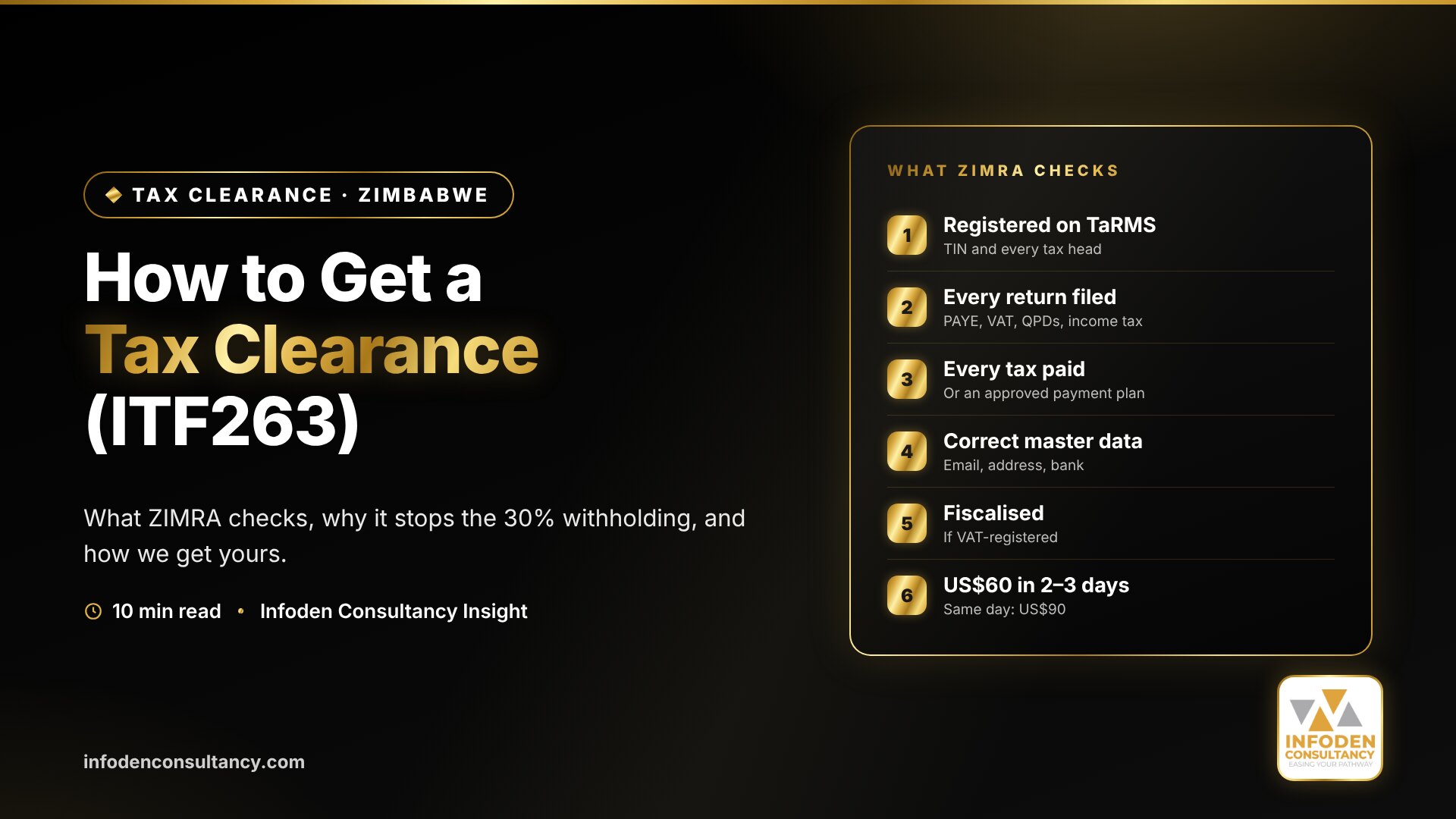
ZIMRA lists the conditions on its own guidance page. Your business must:
- Be registered with ZIMRA and have a TIN (Taxpayer Identification Number) on TaRMS.
- Be up to date with every return for every tax head you are registered for. That includes income tax, QPDs (quarterly payment dates for provisional tax), VAT, PAYE and withholding taxes, if they apply to you.
- Be up to date with every payment under all the Acts ZIMRA runs.
- Have an approved arrangement for anything you owe. If you have a debt, you must agree a payment plan with ZIMRA first.
- Have correct master data. This means your physical address, email address, phone number, bank accounts and industry classification. If ZIMRA has an old email address, it must be changed (on ZIMRA’s Rev 2 form), or the certificate goes to an inbox nobody reads.
- If VAT-registered, be fiscalised. Your fiscal devices must be connected to ZIMRA’s Fiscalisation Data Management System (FDMS), and invoices must show the currency of the sale. See our fiscalisation guide.
One more point catches many small businesses. ZIMRA has said that a business filing only nil returns is treated as not trading, so it needs specific authorisation from ZIMRA before a clearance can be issued. If you are trading, the returns must show real figures.
How does Infoden get your tax clearance?
There is no ITF263 application form any more. The work is making the business compliant, and that is what we do for you. Here is what happens.
- You send us your TIN (or your old BP number) and tell us what the business does and whether it has staff.
- We check your ZIMRA account. If the business is new, we register it. If it had a BP number from before ZIMRA’s current system, we move it across to a TIN.
- We register every tax head you owe. For example: income tax for every company; PAYE once you have employees; VAT if your sales pass the registration threshold. A missing tax head is a common blocker.
- We file every outstanding return under Pending Returns. Anything sitting there blocks your certificate.
- We tell you exactly what is owed and, where needed, arrange a payment plan with ZIMRA.
- We correct your master data: email address, phone number, physical address and bank details.
- We check fiscalisation if you are VAT-registered, and connect your invoicing to FDMS if it isn’t.
- Your ITF263 is issued. Once you are compliant, TaRMS generates the certificate and emails it, and we send you a copy.
Monthly returns such as PAYE and withholding taxes are due by the 5th of the next month, with payment by the 10th, under Statutory Instrument 81 of 2025. Missing one of those dates is the fastest way to lose a clearance you already had. Infoden can keep you on time every month.
How long is a tax clearance valid in 2026?
Look at the validity dates printed on your certificate. They are the only dates that count.
Here is why. ZIMRA’s long-standing guidance said certificates for large and medium taxpayers (LCO and MCO clients) expire on 31 December, and others 12 months from the date of issue. For 2026, ZIMRA’s Public Notice 69 of 2025 announced that certificates would be valid for only one month. After business groups pushed back in December 2025, it was widely reported that ZIMRA would instead issue six-month certificates to large taxpayers and three-month certificates to medium and small taxpayers, including tender bidders.
The practical lesson is the same whichever period applies: your clearance now lapses quickly if you fall behind. Treat compliance as a monthly habit, not a once-a-year chore.
Why didn’t my tax clearance come?
When a certificate doesn’t arrive, the cause is almost always one of these:
| Problem | What fixes it (Infoden does this for you) |
|---|---|
| A pending return on TaRMS (often a QPD, PAYE or nil VAT return) | We file the missing return |
| A balance owing, even a small one | Pay it, or agree a payment plan with ZIMRA |
| A tax head you should be registered for but aren’t (e.g. PAYE with staff) | We register the missing tax and file from its start date |
| ZIMRA has an old email address | Update your master data (Rev 2 form) |
| VAT invoices not fiscalised or not reaching FDMS | Connect your devices to FDMS and fix any offline device |
| Only nil returns while you are trading | Correct the returns with real figures, or seek ZIMRA’s authorisation |
If everything looks clean and still nothing comes, the case has to be taken up with the ZIMRA office that manages your account (Large, Medium or Small Clients Office, or your region). Infoden does that follow-up for you.
How can I check that a supplier’s ITF263 is genuine?
Fake clearances do circulate, and if you rely on one, ZIMRA can make you pay the 30% you should have withheld. ZIMRA can confirm a certificate in three ways, and Infoden can run the check for you:
- By the authentication code printed on the certificate, checked against ZIMRA’s records.
- Barcode: scan the barcode on the ITF263 with a barcode reader or a smartphone.
- Direct confirmation from ZIMRA on a copy of the certificate.
Also check the validity dates and that the name matches the business you are paying.
What changed for professionals in 2026?
The Finance Act No. 7 of 2025, which took effect on 1 January 2026, made two changes for regulated professions such as architects, engineers and surveyors:
- New registrants in those professions no longer need a tax clearance on their first registration with their professional body.
- A professional who is in a dispute with ZIMRA and has lodged an appeal must be given a temporary clearance valid for three months, renewable once for another three months, so they can keep practising while the appeal is decided.
What does a lapsed clearance cost in real money?
Take a small cleaning company with a US$4,000-a-month contract with a parastatal. In March its bookkeeper forgets the February PAYE return. TaRMS shows a pending return, so no new clearance is issued when the old one runs out.
The parastatal must now withhold 30% of every payment: US$1,200 a month. The company can claim it back as a credit against its income tax, but only after its return is assessed, many months later. Meanwhile it still has to pay its staff in full.
One missing return, a few minutes’ work, ties up US$1,200 every month. That is why we tell clients to treat the 5th and the 10th of every month as fixed appointments.
What do tender evaluators check on a tax clearance?
- The name must match the bidding company exactly, as registered with CIPZ.
- The dates must cover the tender closing date. Many evaluators reject a clearance that expires before then.
- It must be genuine. Procuring entities verify certificates with ZIMRA.
- It must match your other documents. PRAZ registration, NSSA compliance and company documents should all name the same entity.
Common mistakes
- Paying a “fixer” who promises a clearance through someone at ZIMRA. ZIMRA asks the public to report anyone claiming to sell clearances. A real clearance comes only from being compliant, which is the work Infoden does.
- Forgetting the small returns. One missing month of PAYE or withholding tax blocks the whole certificate. Keep a calendar. Ours is here.
- Filing nil returns while trading. This doesn’t make you look compliant. ZIMRA treats you as not trading and can refuse the clearance.
- Letting the certificate lapse before a tender closes. With shorter validity in 2026, check that the dates cover the tender’s closing date, not just today.
- Not fiscalising. For VAT-registered businesses, an unconnected device can stop the certificate.
Frequently asked questions
How much does a tax clearance certificate cost in Zimbabwe?
With Infoden it is US$60, all fees included, done in 2–3 days. If you need it the same day, our express service is US$90, within 24 hours. Both cover checking your ZIMRA account, filing what is outstanding and following up until the ITF263 is issued. Any tax you owe to ZIMRA is separate.
Can a new company get a tax clearance?
Yes. Once the company is registered on TaRMS, has the right tax heads and has no outstanding returns or payments, the system can issue one. A brand-new company with nothing owing is often the easiest case.
Can I get a tax clearance if I owe ZIMRA money?
Only with an approved arrangement. ZIMRA says taxpayers with outstanding obligations must agree a payment plan before the certificate can be issued. Keep to the plan, because missing an instalment can stop the next one.
Does a sole trader or individual need an ITF263?
Anyone who supplies goods or services to registered businesses, government or parastatals needs one to be paid without the 30% withholding. The same conditions apply: registered, returns filed and taxes paid.
What if I didn’t get the tax clearance email?
Check the inbox linked to your ZIMRA profile, including spam. If it isn’t there, Infoden can download the certificate from TaRMS for you and correct the email address on record so future certificates reach you.
What to do next
Send Infoden your TIN today. We will tell you what is blocking your clearance and fix it, whether that is one late return or years of missing filings.
Tax clearance with Infoden is US$60, all fees included, in 2–3 days, or US$90 for same-day express within 24 hours. See our tax and ZIMRA services.
Need your ITF263 sorted?
US$60 in 2–3 days, or US$90 the same day. Send us your TIN and we’ll tell you what is blocking your clearance.
Sources and law
- ZIMRA: What is an ITF263? (conditions, auto-generation, validity). Checked 22 November 2026.
- ZIMRA: Tax clearances issued through TaRMS (from 1 January 2024). Checked 22 November 2026.
- ZIMRA: Authentication of a tax clearance. Checked 22 November 2026.
- ZIMRA Public Notice 61 of 2026 (monthly returns by the 5th, payments by the 10th, under SI 81 of 2025). Checked 22 November 2026.
- KPMG Zimbabwe: 2026 National Budget highlights (Finance Act changes for professionals). Checked 22 November 2026.
- The Zimbabwean, December 2025: ZIMRA drops the monthly tax clearance rule (reported 6- and 3-month validity).
- Income Tax Act [Chapter 23:06], section 80.
This is general information, not legal or tax advice for your specific situation. Contact Infoden for advice on your situation.