How Do I Register as an Employer with NSSA?
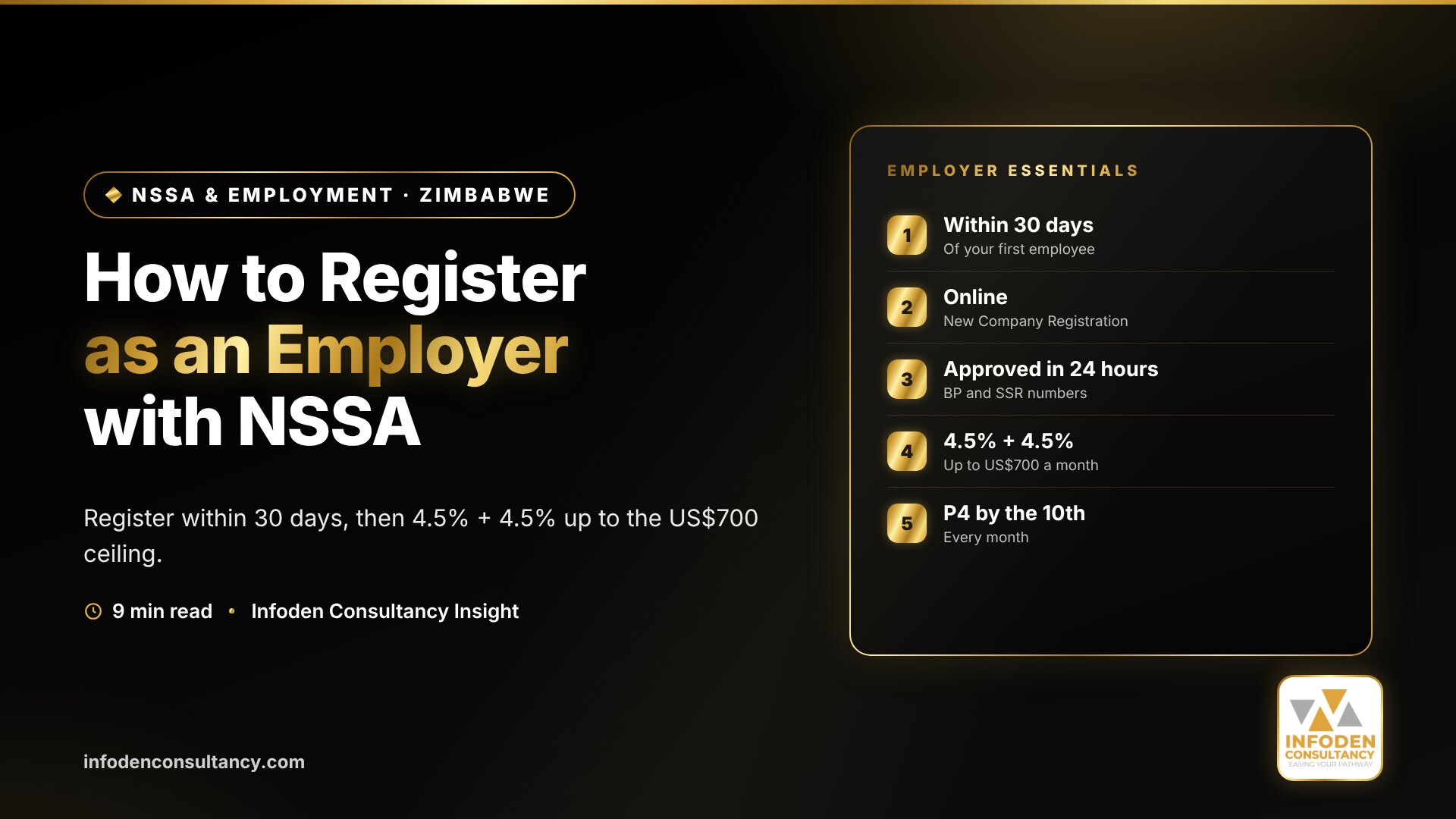
Register with NSSA within 30 days of hiring: what Infoden needs from you, 4.5% + 4.5% contributions up to US$700, workers’ compensation and the P4.
Short answer
Every employer in Zimbabwe must register with NSSA within 30 days of becoming an employer. Infoden registers you for US$40, and NSSA approves new companies within 24 hours. You then pay 4.5% of each worker’s insurable earnings, matched by 4.5% from the worker, up to a US$700 ceiling, plus a workers’ compensation premium.
The day you pay your first salary, you become an employer in NSSA’s eyes, and social security contributions are due that month. It doesn’t matter if you have one worker or a hundred, or if staff already have a private pension: NSSA membership is compulsory.
This guide explains what NSSA covers, how to register, what you will pay, the monthly forms, and the mistakes that lead to arrears and penalties.
| Key fact | Answer |
|---|---|
| Authority | NSSA, the National Social Security Authority |
| Who must register | Every employer, with any number of employees |
| Deadline | Within 30 days of becoming an employer |
| Who does it | Infoden, for US$40 |
| Approval | Within 24 hours of registration, according to NSSA |
| Pension contributions (POBS) | 4.5% employer + 4.5% employee, on insurable earnings up to US$700 a month |
| Workers’ compensation (APWCS) | Employer-only premium, at a rate set for your industry |
| Monthly | P4 return and payment, which Infoden can file for you |
What does NSSA cover?
NSSA runs two compulsory schemes, and as an employer you are in both:
- POBS, the Pension and Other Benefits Scheme. It pays retirement, invalidity and survivors’ pensions and funeral grants. Employer and employee both contribute.
- APWCS, the Accident Prevention and Workers Compensation Scheme. It covers workers injured at work or who fall ill because of their work. Only the employer pays.
Which workers are covered?
For POBS, NSSA covers employees above 16 and below 65 who work in a profession, trade or occupation, both Zimbabwean citizens and people ordinarily resident in Zimbabwe. Deductions stop at 65, even if the person keeps working. Membership is compulsory even if the worker also has a private pension.
For APWCS, cover is wider: all formally employed workers above 16, including those over 65. NSSA says that once you engage an employee they should be covered, even if the job lasts only a few hours.
Casual workers count too. NSSA treats a casual worker as insurable when they work in any 6 weeks of a 12-week period, or are paid for at least 18 days in one calendar month by the same employer.
How does Infoden register you with NSSA?
Infoden does the NSSA registration for you. Here is what we need from you and what happens.
- You send us the details: what the business does (the industry), the company type, the date you started employing people, your total wage bill (total basic salaries), contact details and physical address, bank details, the directors, and a contact person whose email you check.
- You send us each employee’s details: name, national ID number, date of birth, start date and salary. We put them on NSSA’s employee template.
- We attach the company documents NSSA asks for, the Certificate of Incorporation and memorandum and articles, from your company file.
- We submit your registration to NSSA and follow it up until it is approved.
- You receive your numbers. NSSA approves a new company within 24 hours and issues your BP number and SSR number (Social Security Registration number), which appear on every NSSA communication.
- We set up your employer account with NSSA so the monthly P4 can be filed.
Each employee gets a lifelong Social Security Number (SSN) and card, which stays the same when they change jobs. If you hire someone who is already an NSSA member, their employment is updated with NSSA rather than registered again.
A business with branches in the same industry registers once. Businesses in different industries register separately.
How much will I pay?
Pensions (POBS)
You deduct 4.5% of each employee’s insurable earnings and add another 4.5% yourself, so 9% in total goes to NSSA. Insurable earnings are capped at a ceiling of US$700 a month, which NSSA says is gazetted quarterly. The most anyone contributes is therefore US$31.50 from the employee and US$31.50 from the employer, US$63 a month in all.
| Monthly basic pay | Employee 4.5% | Employer 4.5% | Total to NSSA |
|---|---|---|---|
| US$300 | US$13.50 | US$13.50 | US$27.00 |
| US$500 | US$22.50 | US$22.50 | US$45.00 |
| US$700 or more | US$31.50 | US$31.50 | US$63.00 |
Contributions are worked out on basic pay. Under NSSA’s clarification of SI 169 of 2021, where allowances are more than basic pay, they are worked out on basic pay plus allowances, still up to the ceiling. The employee’s NSSA contribution also comes off their pay before PAYE is calculated.
Workers’ compensation (APWCS)
The employer alone pays a premium on the total wage bill. The rate depends on your industry’s risk: each industry has a code, and its rate is reviewed and gazetted. We confirm your industry’s current rate when we register you, and check it again at the end of each year.
What do I file every month?
- P4, the monthly return. Filed every month, right after your payroll run and no later than the 10th of the following month. It tells NSSA what you are paying, for which period, and how it splits between the two schemes.
- P4A, the remittance advice, a breakdown per employee, so each worker’s account is credited.
- P4C, employee modifications, for workers who left during the month.
- WC50, the wages declaration, completed once a year from NSSA’s summary, so NSSA can set your workers’ compensation rate for the following year.
NSSA accepts payment in cash, by RTGS transfer, by mobile money or through another RBZ-authorised method. Infoden can prepare the P4 and P4A each month so every payment is credited correctly.
What records must I keep?
For every employee, keep the date and amount of their earnings each pay period, the NSSA deduction from their pay, and your own contribution for each month. Also keep a monthly summary of how many people you employed and your total wage bill. NSSA inspectors can ask to see these records at any reasonable time.
Tell NSSA in writing within one month if your address changes or you close the business or a branch.
What happens if I don’t register or pay?
If you fail to register, pay late or pay too little, NSSA recovers the arrears together with surcharges, penalties and interest. NSSA is clear that an employer who fell behind through negligence or fraud cannot pass those surcharges, penalties or interest on to employees. They come out of your pocket.
Many tenders also ask for proof of NSSA compliance with the bid. Arrears can cost you contracts as well as penalties.
Example: the first payroll for three staff
A new company employs three people on monthly basic pay of US$400, US$600 and US$900.
| Employee | Basic pay | Insurable (max US$700) | Employee 4.5% | Employer 4.5% |
|---|---|---|---|---|
| A | US$400 | US$400 | US$18.00 | US$18.00 |
| B | US$600 | US$600 | US$27.00 | US$27.00 |
| C | US$900 | US$700 | US$31.50 | US$31.50 |
| Total | US$76.50 | US$76.50 |
The company pays NSSA US$153 for pensions for the month, of which US$76.50 was deducted from salaries, plus its workers’ compensation premium at its industry rate on the US$1,900 wage bill. It files the P4 and pays by the 10th of the next month. The same month it also files PAYE with ZIMRA by the 5th and pays by the 10th.
How do NSSA and PAYE fit together on a payslip?
The employee’s 4.5% NSSA deduction comes off their pay before PAYE is worked out, so it slightly reduces their income tax. The employer’s 4.5% and the workers’ compensation premium are the employer’s own costs and don’t appear as deductions on the payslip. Get NSSA right first, and the PAYE calculation follows.
Common mistakes
- Waiting until “the business is bigger”. The 30 days start with your first employee, not your tenth.
- Leaving out casual or part-time staff. Under the 6-in-12-weeks and 18-days rules, many casuals are insurable, and APWCS covers every worker.
- Deducting past 65. POBS deductions stop at 65, and NSSA refunds contributions paid in error only if you apply within twelve months after the end of the year in which they were paid.
- Using the old rate. Some guides still say 3.5%. NSSA’s current rate is 4.5% each, up to the US$700 ceiling.
- Paying without the P4. Money paid without a correct P4 may not reach the right employees’ accounts.
Frequently asked questions
Do I need to register with NSSA if I have only one employee?
Yes. Every employer must register within 30 days of becoming an employer, whatever the number of workers. One employee is enough.
Do directors who are paid a salary count as employees for NSSA?
A director who is paid a salary under a contract of employment is an employee and is covered like any other worker. A director who only receives directors’ fees or dividends is in a different position, so check their contract.
Is the NSSA ceiling in US dollars even if I pay in ZiG?
The ceiling NSSA publishes is US$700. If you pay salaries in ZiG, you convert at the applicable rate to apply the ceiling.
Who can register my business with NSSA?
Infoden does it for you, for US$40. You send us the business and employee details, and we submit the registration, follow it up and set up your employer account for the monthly P4.
What to do next
If you already employ anyone and aren’t registered, contact Infoden this week. The 30 days may already have passed.
Infoden registers employers with NSSA for US$40 and can run your monthly NSSA and PAYE with payroll from US$15 a month (under 5 employees). See our NSSA registration service.
Hiring your first employee?
We’ll register you with NSSA and set up your monthly P4 so contributions are right from the first payslip.
Sources and law
- NSSA: Registrations (30 days, BP and SSR numbers, changes). Checked 22 November 2026.
- NSSA: Contributions (4.5% each, US$700 ceiling, P4, P4A, P4C, WC50, payment, arrears). Checked 22 November 2026.
- NSSA: Coverage (ages, casual workers, APWCS). Checked 22 November 2026.
- NSSA: Record keeping. Checked 22 November 2026.
- National Social Security Authority Act [Chapter 17:04]; SI 169 of 2021 (insurable earnings); Income Tax Act [Chapter 23:06], section 15(2)(h).
This is general information, not legal or tax advice for your specific situation. Contact Infoden for advice on your situation.