How Do I Register My Business with ZIMRA?
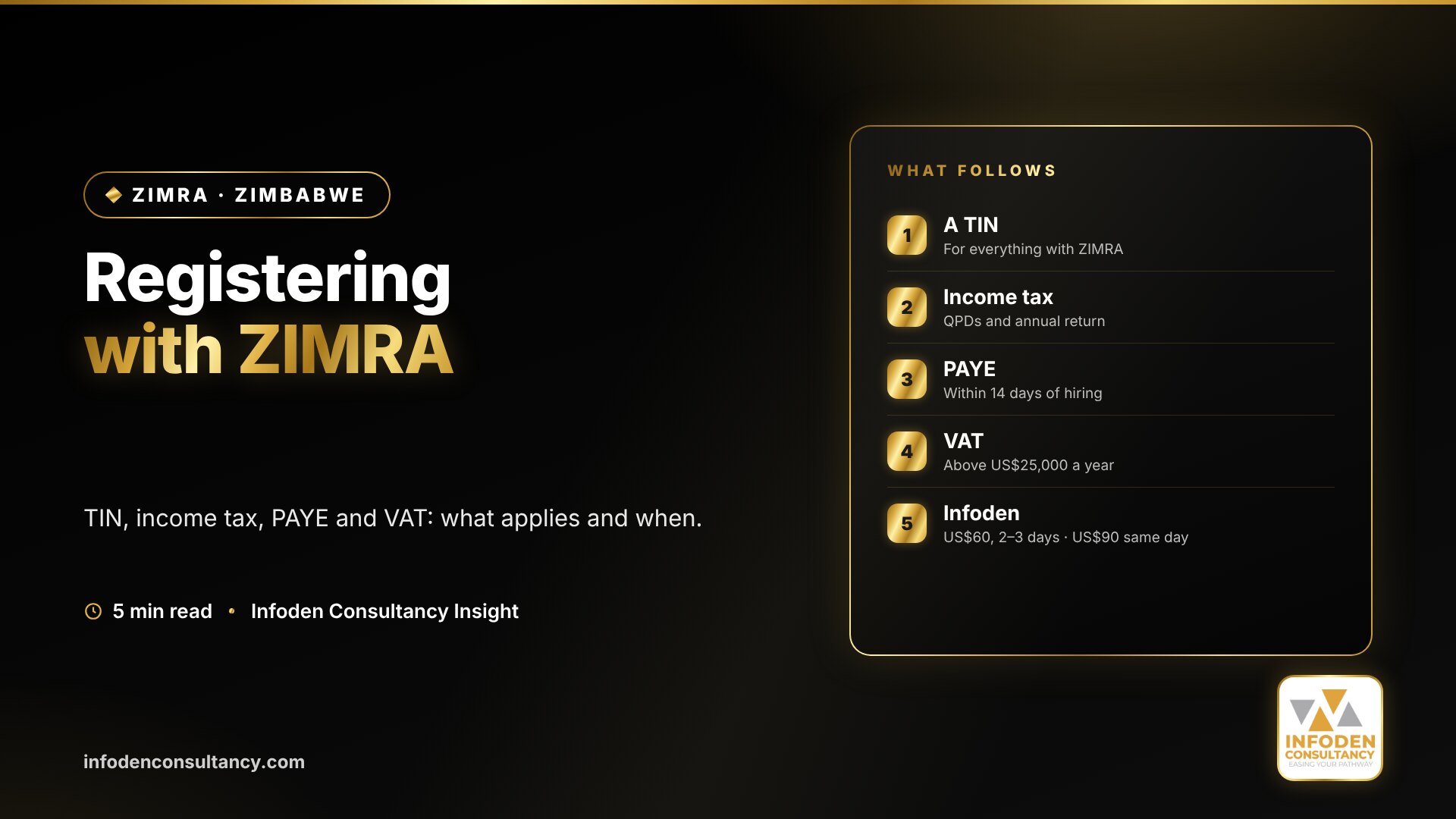
Register your business with ZIMRA: TIN, income tax, PAYE within 14 days of hiring, VAT over US$25,000. Infoden does it for US$60 in 2–3 days.
Short answer
Every business in Zimbabwe, from a sole trader to a company, must register with ZIMRA and get a TIN (Taxpayer Identification Number), then register for each tax it owes: income tax, PAYE within 14 days of employing anyone, and VAT above US$25,000 of sales. Infoden does the whole registration for US$60 in 2–3 days, or US$90 the same day.
Registering your company with CIPZ makes it exist. Registering with ZIMRA makes it able to trade properly: to issue invoices clients will pay in full, to employ staff and to get a tax clearance.
Here is what ZIMRA registration involves, what we need from you, and what follows.
| Key fact | Answer |
|---|---|
| Who must register | Individuals, companies, partnerships and cooperatives that start a business |
| What you get | A TIN, used for every dealing with ZIMRA, including paying tax |
| Then register for | Income tax; PAYE once you employ anyone; VAT once taxable sales pass US$25,000 a year |
| PAYE deadline | Within 14 days of becoming an employer |
| Infoden | US$60 in 2–3 days; same-day express US$90 within 24 hours; all fees included |
Who has to register with ZIMRA?
ZIMRA says everyone who goes into business must register: individuals, companies, partnerships and cooperatives. It doesn’t matter how small the business is. A newly registered company should register with ZIMRA before it starts trading.
What does ZIMRA registration give my business?
A TIN, the Taxpayer Identification Number. It is the business’s number for everything with ZIMRA: returns, payments, tax clearance and customs. When you pay tax at the bank, the TIN is how the money reaches your account. Businesses registered before ZIMRA’s current system had a BP (Business Partner) number, which has been replaced by the TIN.
Registration also links the business to a bank that holds ZIMRA’s single account, so the business must already have a bank account.
Which taxes will my business be registered for?
| Tax | When it applies | What follows |
|---|---|---|
| Income tax | Every business with income from trade | Four QPDs a year and an annual return by 30 April |
| PAYE | Within 14 days of employing anyone | Monthly return by the 5th, payment by the 10th; an annual ITF16 within 30 days of the year end |
| VAT | Taxable sales of more than US$25,000 a year, or likely to pass it | VAT returns monthly or every two months, and fiscalised invoices |
| Withholding taxes | When you pay suppliers without a tax clearance, among others | Monthly return by the 5th, payment by the 10th |
Some small operators, such as minibus and taxi operators, hairdressers and informal traders, pay presumptive tax instead of the usual income tax rules.
How does Infoden register my business with ZIMRA?
- You send us the details: the company name and registration number, what the business does, its address and contact details, the directors’ details, the bank you use, and whether you employ anyone.
- We register the business with ZIMRA and get its TIN, linked to your bank.
- We register the taxes it owes: income tax, and PAYE and VAT where they apply.
- We set up your obligations so the first QPD, PAYE and VAT dates are on your calendar from day one.
- We apply for your tax clearance (ITF263) once the business is compliant, if you choose our Compliance Essentials package or the tax clearance service.
It takes 2–3 days for US$60. If you need it the same day, for a tender or a contract, our ZIMRA express service is US$90, done within 24 hours.
What must the business do after registering?
- Keep records for at least six years, as ZIMRA requires.
- File and pay on time: QPDs, monthly PAYE and withholding taxes, VAT, and the annual return. Our 2027 compliance calendar lists every date.
- Tell ZIMRA about changes, such as a new address, a change of partners or stopping trade.
- Fiscalise if VAT-registered, so every sale reaches ZIMRA’s FDMS.
Common mistakes
- Trading before registering. Clients can’t verify you, and without a tax clearance they must withhold 30% of every payment.
- Registering for income tax but not PAYE. The 14-day deadline starts with your first employee.
- Staying unregistered for VAT after passing US$25,000. ZIMRA can assess the VAT you should have charged, plus penalties.
- Filing nil returns while trading. ZIMRA treats a nil filer as not trading, which blocks the tax clearance.
Frequently asked questions
How long does ZIMRA registration take with Infoden?
2–3 days for US$60, all fees included. If you need it the same day, our ZIMRA express service is US$90 and is done within 24 hours.
Do I need ZIMRA registration if I am a sole trader?
Yes. ZIMRA requires individuals who go into business to register, not only companies. A sole trader’s TIN works the same way as a company’s.
What is the difference between a TIN and a BP number?
The TIN is the current number under ZIMRA’s system. Older businesses had a BP (Business Partner) number, which has been moved across to a TIN. If your business still only has a BP number, Infoden moves it across for you.
Does ZIMRA registration give me a tax clearance?
Not on its own. ZIMRA issues the ITF263 once the business is registered for the right taxes and up to date with returns and payments. Infoden’s tax clearance service gets it issued for US$60 in 2–3 days.
What to do next
Send Infoden your company details and tell us whether you employ anyone. We register you with ZIMRA in 2–3 days for US$60, or the same day for US$90.
See our tax and ZIMRA services.
Registered with ZIMRA in 2–3 days
US$60, or US$90 the same day. All fees included.
Sources and law
- ZIMRA: New businesses (who must register, TIN, bank link, provisional tax, presumptive tax, VAT threshold, PAYE within 14 days, ITF16, six-year records). Checked 24 November 2026.
- ZIMRA Public Notice 61 of 2026 (monthly returns by the 5th, payments by the 10th). Checked 24 November 2026.
- Income Tax Act [Chapter 23:06]; Value Added Tax Act [Chapter 23:12].
This is general information, not legal or tax advice for your specific situation. Contact Infoden for advice on your situation.