What Is the VAT Rate in Zimbabwe in 2026, and What Changed?
Zimbabwe’s VAT rate is 15.5% from 1 January 2026 (was 15%). Who must register (US$25,000), filing categories, FDMS input tax and 2027 proposals.
Short answer
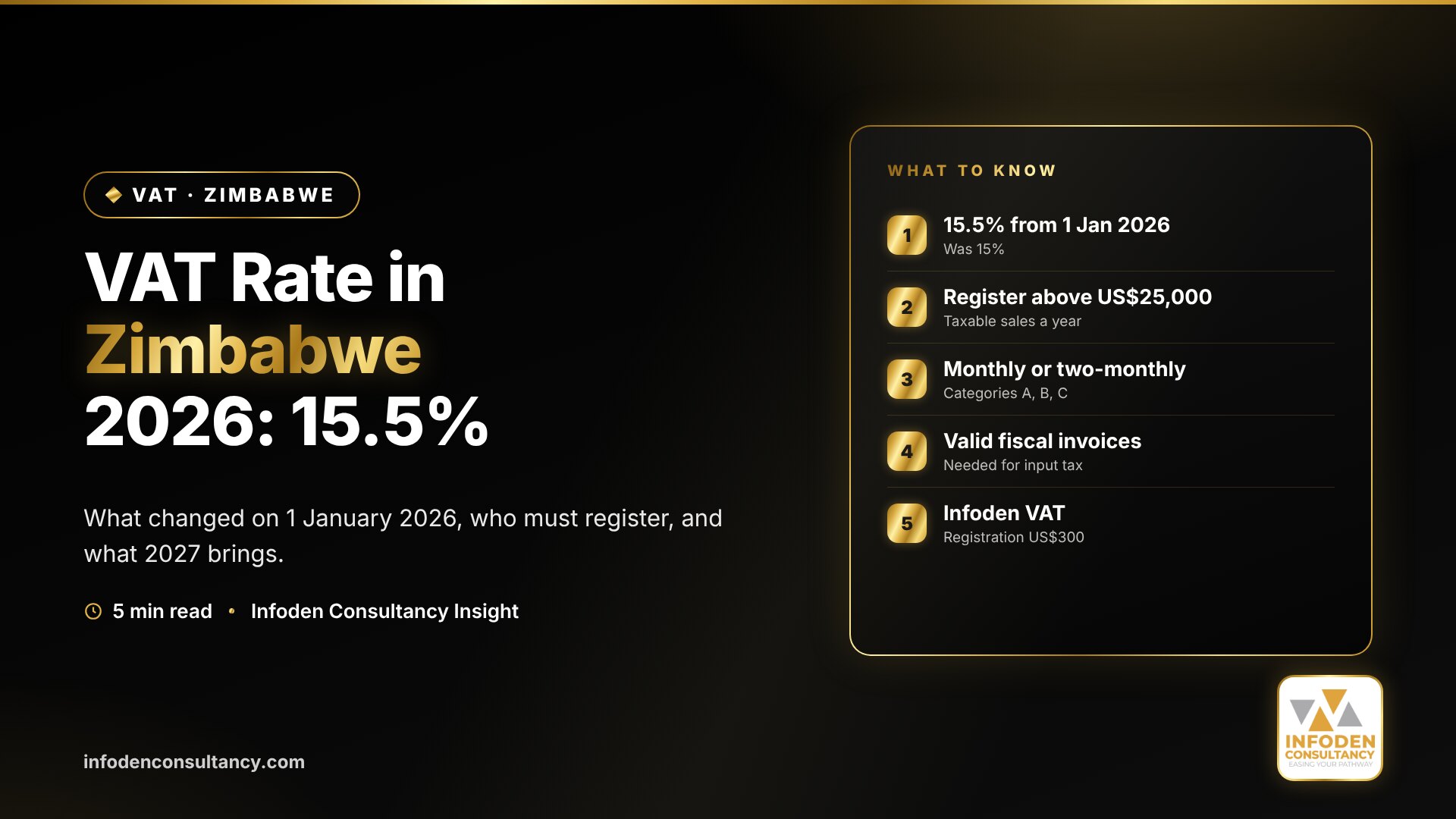
The standard VAT rate in Zimbabwe is 15.5% from 1 January 2026. It was 15% until 31 December 2025. The change came with the 2026 National Budget and the Finance Act No. 7 of 2025. Businesses must register for VAT once their taxable sales pass US$25,000 a year, and Infoden handles the registration and the returns for you.
Half a percent sounds small. But on every invoice, every price list and every till, it changes the numbers. And in January 2026 it caught many businesses mid-return, because one VAT period spanned both rates.
Here is what changed, who it affects, and what else moved in VAT this year.
| Key fact | Answer |
|---|---|
| Standard VAT rate | 15.5% from 1 January 2026 (15% before) |
| Law | Value Added Tax Act [Chapter 23:12], as amended by the Finance Act No. 7 of 2025 |
| Registration threshold | Taxable sales of more than US$25,000 a year (or the ZiG equivalent), or likely to pass it |
| Returns | Monthly (category C) or every two months (categories A and B) |
| Since 2026 | Input tax only on fiscal invoices that ZIMRA’s FDMS shows as valid |
| Infoden | VAT registration US$300; VAT returns US$30 a month; all fees included |
What is the VAT rate in Zimbabwe now?
15.5%. The 2026 National Budget raised the standard rate from 15% to 15.5% with effect from 1 January 2026, and ZIMRA confirmed it in Public Notice 7 of 2026. Zero-rated supplies stay at 0% and exempt supplies stay exempt.
So a product that sold for US$100 plus VAT now costs the customer US$115.50, not US$115.
What happened to returns that covered December and January?
Businesses in VAT category A file every two months, and their December 2025/January 2026 return covered both rates. ZIMRA’s system worked that return out at 15.5%, so ZIMRA told category A businesses to adjust the December figures so that December’s output tax stayed at 15%, and to attach a summary of both months to the return.
The same care applies to any 2025 sale that is only accounted for in 2026 under the time-of-supply rules in section 8 of the VAT Act. If your December or January figures were not adjusted, the return may need correcting.
Who must register for VAT?
Any person whose taxable sales are more than US$25,000 a year, or are likely to pass it, must register, according to ZIMRA. Below that, voluntary registration can still make sense, for example if your customers are VAT-registered businesses that want to claim input tax.
Once registered, ZIMRA puts you in a category that decides how often you file:
| Category | How often |
|---|---|
| A and B | Every two months (A and B cover different pairs of months) |
| C | Every month |
| D | Special periods allowed by the Commissioner |
In 2026, ZIMRA’s notices set VAT returns for the 10th of the month after the period and payment for the 15th.
What else changed in VAT in 2026?
- Input tax only on valid fiscal invoices. From the 2026 periods, ZIMRA fills in input tax automatically from FDMS (its Fiscalisation Data Management System). Only invoices that FDMS shows as valid, with the buyer’s details on them, can be claimed. See our fiscalisation guide.
- Digital services. From 1 January 2026, banks and other intermediaries withhold tax when someone in Zimbabwe pays a foreign supplier for electronic services such as subscriptions and online platforms (ZIMRA Public Notice 5 of 2026). Physical goods bought online still pay import VAT at the border.
- Imported services. The Finance Act requires VAT on imported services to be paid in foreign currency, with penalties for not paying it.
Is VAT changing again in 2027?
The 2027 National Budget, presented on 19 November 2026, does not raise the standard rate. It proposes exempting fresh-water fish from VAT and introducing much heavier penalties for VAT-registered businesses that fail to fiscalise or file returns. These are proposals until the Finance Act is passed, and we will update this page when it is.
Common mistakes
- Old price lists and templates still at 15%. Every invoice from 1 January 2026 should charge 15.5%.
- Claiming input tax on invoices that are not fiscalised. Since 2026 those claims fail. Ask suppliers for valid fiscal invoices with your details.
- Waiting to register. If your sales passed US$25,000 and you didn’t register, ZIMRA can assess the VAT you should have charged, plus penalties.
Frequently asked questions
When did VAT go up to 15.5% in Zimbabwe?
On 1 January 2026. The increase was announced in the 2026 National Budget, enacted by the Finance Act No. 7 of 2025, and confirmed by ZIMRA in Public Notice 7 of 2026.
What is the VAT registration threshold in Zimbabwe?
US$25,000 of taxable sales a year, or the ZiG equivalent. A business that passes it, or expects to, must register for VAT.
How much does Infoden charge for VAT registration?
US$300, all fees included, with monthly VAT returns from US$30 a month. We work out your category, register you and keep your returns on time.
Do I charge 15.5% on a sale made in December but invoiced in January?
It depends on when the supply took place under section 8 of the VAT Act. Where the supply happened in 2025, the 15% rate applies even if you account for it in 2026, and ZIMRA set out how to declare it. Contact Infoden if your December and January figures overlap.
What to do next
Check that every price list, invoice template and till charges 15.5%, and that your suppliers’ invoices are fiscalised with your details.
If you need to register, or want your returns handled, Infoden registers businesses for VAT for US$300 and files VAT returns from US$30 a month. See our tax services.
VAT registered and filed on time
Registration US$300, returns from US$30 a month, all fees included.
Sources and law
- ZIMRA Public Notice 7 of 2026 (15.5% from 1 January 2026; category A returns), issued 9 February 2026; Public Notice 5 of 2026 (digital services); Public Notice 49 of 2026 (due dates; FDMS input tax). Checked 24 November 2026.
- ZIMRA: New businesses (US$25,000 VAT threshold). Checked 24 November 2026.
- KPMG Zimbabwe: 2026 National Budget highlights. Checked 24 November 2026.
- Lucent Consultancy: 2027 National Budget highlights (proposals). Checked 24 November 2026.
- Value Added Tax Act [Chapter 23:12], sections 8 and 13A; Finance Act No. 7 of 2025.
This is general information, not legal or tax advice for your specific situation. Contact Infoden for advice on your situation.