
What Happens If You Don't File Annual Returns in Zimbabwe
What Happens If You Don't File Annual Returns in Zimbabwe. Imagine this...
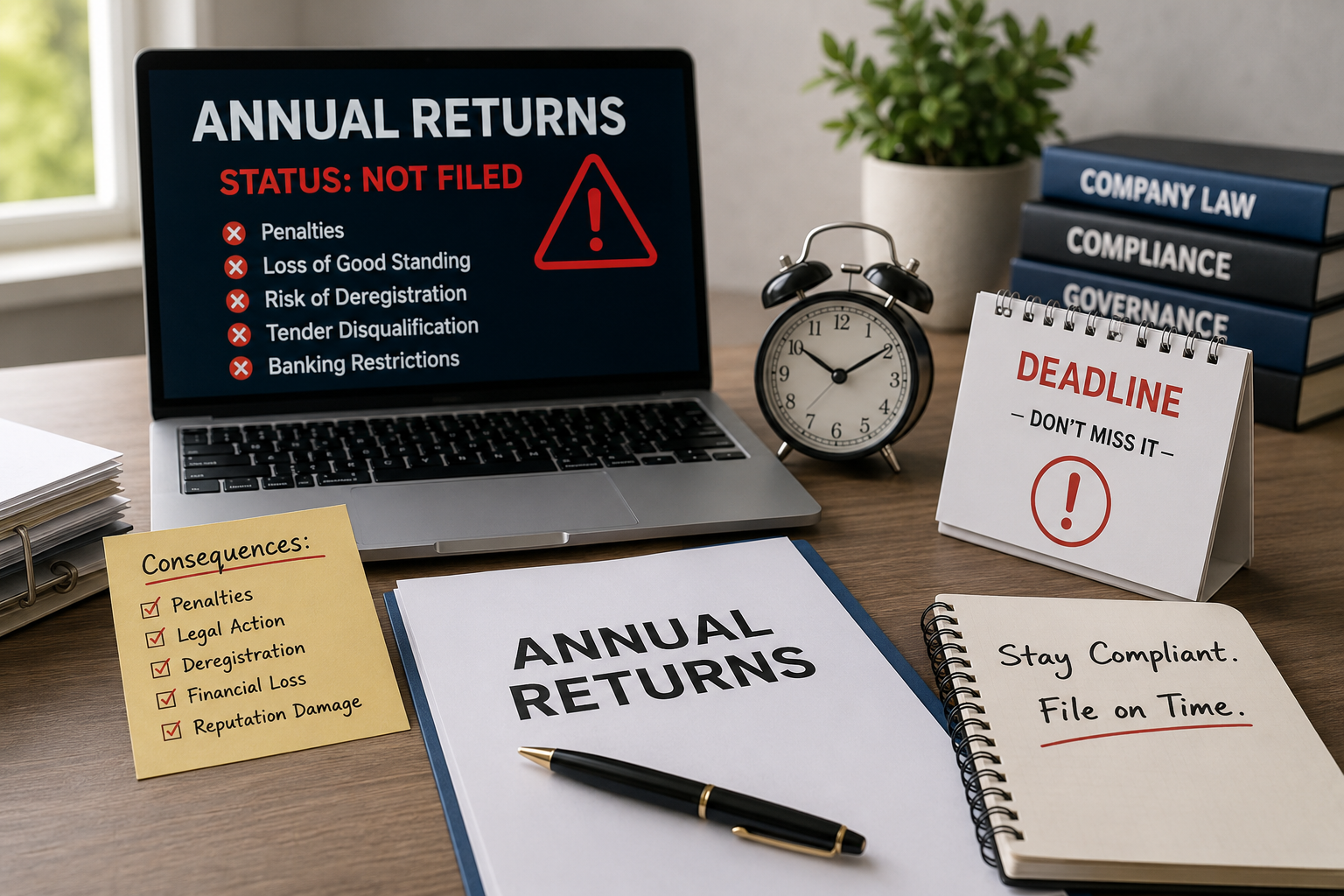
What Happens If You Don't File Annual Returns in Zimbabwe?
Imagine this.
You've successfully registered your company. Business is picking up. Clients are coming in, invoices are being paid, and you're focused on growing your enterprise.
Then one day, a bank requests your company documents for a loan application. Or you're bidding for a lucrative government tender. Or an investor wants to conduct due diligence.
Everything seems fine—until you discover your company is no longer in good standing because you haven't been filing annual returns.
Many business owners in Zimbabwe mistakenly believe that once a company is registered, there is nothing else to do. Unfortunately, that's one of the most expensive misconceptions a director can make.
Annual returns are not optional. They are a legal obligation that keeps your company compliant and confirms that it continues to exist and operate.
Ignoring this requirement can result in penalties, administrative headaches, and in serious cases, the company being struck off the Companies Register.
This guide explains exactly what annual returns are, what happens if you fail to file them, and how you can avoid unnecessary risks.
Primary Keyword
Annual Returns Zimbabwe
Secondary Keywords
File annual returns Zimbabwe
Company compliance Zimbabwe
Company annual returns
Registrar of Companies Zimbabwe
Company deregistration Zimbabwe
Company compliance services
CIPA annual returns
Company filing requirements Zimbabwe
Long-Tail Keywords
What happens if you don't file annual returns in Zimbabwe?
Penalties for late annual returns in Zimbabwe
How to file annual returns in Zimbabwe
Can a company be deregistered for not filing annual returns?
Why are annual returns important in Zimbabwe?
Search Intent
Informational with strong commercial intent.
What Are Annual Returns?
Annual returns are statutory documents submitted to the Registrar of Companies to confirm that your company still exists and that its information remains accurate.
Think of them as your company's annual "health check."
Unlike tax returns, annual returns are not primarily about paying taxes. Instead, they keep the Companies Office updated on key company information, such as:
Registered office address
Directors
Company secretary (where applicable)
Shareholders
Share capital
Company status
By filing annual returns, a company demonstrates that it is still active and compliant with the Companies and Other Business Entities Act [Chapter 24:31].
Why Filing Annual Returns Matters
Many directors only appreciate the importance of annual returns when something goes wrong.
In reality, filing annual returns provides several benefits.
It helps:
Maintain your company's legal standing
Improve credibility with banks and investors
Support tender applications
Facilitate due diligence
Reduce compliance risks
Keep company records accurate
Demonstrate good corporate governance
Businesses that remain compliant generally find it much easier to obtain financing, attract investors and secure contracts.
What Happens If You Don't File Annual Returns?
Ignoring annual returns doesn't usually cause immediate problems.
That's what makes it dangerous.
The consequences often build slowly until they become expensive.
1. Your Company Falls Out of Good Standing
The first consequence is that your company may no longer be regarded as fully compliant.
This becomes obvious when applying for:
Government tenders
Bank loans
Investor funding
Corporate partnerships
Supplier registrations
Many organisations perform compliance checks before doing business.
Non-compliance raises red flags.
2. Financial Penalties
Late filing often attracts penalties.
The longer annual returns remain outstanding, the greater the cost of becoming compliant again.
Instead of paying only the normal filing fees, businesses frequently end up paying accumulated penalties covering several years.
For companies that have neglected compliance for a long period, these costs can become substantial.
3. Your Company May Be Struck Off the Register
One of the most serious consequences is deregistration.
Where a company consistently fails to comply with statutory filing requirements, the Registrar may begin the process of removing it from the Companies Register.
Once struck off:
The company effectively ceases to exist as a legal entity.
Business transactions become problematic.
Assets may become difficult to manage.
Contracts may be affected.
Restoring the company can be expensive and time-consuming.
Many business owners don't realise this risk until they urgently need proof that their company still legally exists.
4. Banking Challenges
Banks increasingly conduct compliance checks.
An inactive or non-compliant company may experience delays when:
Opening bank accounts
Applying for loans
Updating signatories
Accessing trade finance
Financial institutions prefer dealing with businesses that maintain proper statutory records.
5. Problems During Tender Applications
Government and corporate procurement processes require extensive compliance documentation.
Missing annual returns can delay or even disqualify an application.
If you've invested significant time preparing a tender submission, losing the opportunity over avoidable compliance issues is particularly frustrating.
6. Investor Concerns
Investors conduct due diligence before committing capital.
One of the first things they examine is statutory compliance.
Failure to file annual returns may signal poor governance or weak internal controls.
Even profitable businesses can lose investment opportunities because of preventable compliance issues.
7. Difficulties Updating Company Information
Need to change directors?
Transfer shares?
Update your registered office?
These routine corporate changes often become more complicated if annual returns are outstanding.
Businesses frequently have to bring their compliance up to date before other filings can be processed.
Real-World Business Scenario
Consider a growing construction company that has operated successfully for five years.
The directors assumed annual returns weren't necessary because they had been paying taxes.
When the company won a major procurement opportunity, compliance checks revealed several years of outstanding annual returns.
The directors had to urgently regularise their filings, pay accumulated penalties and delay contract execution.
The contract was eventually secured—but only after unnecessary stress, additional costs and lost time.
This situation is more common than many people realise.
Tax Returns vs Annual Returns
Many people confuse these two obligations.
Annual Returns | Tax Returns |
|---|---|
Filed with the Registrar of Companies | Filed with ZIMRA |
Maintain company legal status | Report taxable income |
Concern company information | Concern tax obligations |
Required even if no tax is payable | Required according to tax laws |
One does not replace the other.
A company may be tax compliant while still failing its company law obligations.
Common Mistakes People Make
1. Assuming Company Registration Is a Once-Off Process
Registration is only the beginning.
Companies have ongoing statutory responsibilities.
How to avoid it
Create a yearly compliance calendar.
2. Confusing Tax Compliance with Company Compliance
Many directors believe paying taxes means they're fully compliant.
They are separate legal requirements.
How to avoid it
Manage both company filings and tax obligations independently.
3. Waiting Until a Tender Requires Compliance
Many businesses only react when documentation is urgently needed.
By then, penalties may already have accumulated.
How to avoid it
Stay compliant throughout the year.
4. Ignoring Reminder Notices
Some businesses overlook compliance notices until serious action begins.
How to avoid it
Treat every statutory notice as important.
5. Not Updating Company Records
Directors move.
Addresses change.
Shareholding changes.
Ignoring these updates creates inaccurate public records.
How to avoid it
Update company information whenever significant changes occur.
Expert Perspective
Business compliance is becoming more important, not less.
Banks, investors, procurement authorities and corporate clients are placing greater emphasis on governance and regulatory compliance during due diligence.
Businesses with strong compliance records tend to secure financing more easily, inspire greater confidence among partners and avoid unnecessary operational disruptions.
Annual returns should therefore be viewed as more than a legal requirement—they're part of building a credible, investment-ready business.
Many successful companies treat compliance as a strategic asset rather than an administrative burden.
That mindset often pays dividends over the long term.
Frequently Asked Questions
1. Are annual returns mandatory in Zimbabwe?
Yes. Companies are generally required to file annual returns to maintain compliance with the Companies and Other Business Entities Act.
2. What happens if I miss the filing deadline?
You may become liable for penalties and risk further regulatory action if the non-compliance continues.
3. Can my company be deregistered?
Yes. Persistent failure to meet statutory obligations can ultimately lead to removal from the Companies Register.
4. Are annual returns the same as tax returns?
No. Annual returns relate to company law, while tax returns relate to taxation.
5. Do dormant companies need to file annual returns?
In many cases, yes. A company's legal obligations do not necessarily cease simply because it is inactive.
6. Can outstanding annual returns be filed later?
Yes, although penalties and additional administrative requirements may apply.
7. How often must annual returns be filed?
Generally, annually, in accordance with applicable legal requirements.
8. What information is included?
Company particulars, registered office, directors, shareholders and other statutory information.
9. Will non-compliance affect tenders?
It can. Many procurement processes require proof of statutory compliance.
10. Can I file annual returns myself?
While possible, many businesses engage compliance professionals to ensure filings are accurate and submitted on time.
11. Does filing annual returns improve business credibility?
Yes. It demonstrates good governance and responsible corporate management.
12. How can I know whether my company is compliant?
A compliance review can identify outstanding statutory obligations and determine whether corrective action is needed.
Action Checklist
Use this checklist to keep your company compliant:
☐ Confirm your company's annual return filing status.
☐ Review your registered office details.
☐ Verify director and shareholder information.
☐ Update any outdated company records.
☐ Keep copies of previous filings.
☐ Maintain a compliance calendar with filing deadlines.
☐ Separate company law compliance from tax compliance.
☐ Address outstanding filings promptly to minimise penalties.
☐ Conduct a periodic compliance review.
☐ Seek professional advice if you're unsure of your obligations.
Conclusion
Failing to file annual returns in Zimbabwe is more than an administrative oversight. It can expose your business to penalties, compliance issues, reputational damage and, in serious cases, deregistration.
The good news is that these risks are largely preventable.
By understanding your statutory obligations, keeping your company records current and filing annual returns on time, you strengthen your company's legal standing and position it for future opportunities.
Whether you're applying for funding, pursuing government tenders or planning for long-term growth, maintaining compliance is an investment in your business's credibility and resilience.
Need Help?
If you're unsure whether your company is up to date with its annual returns or other statutory obligations, Infoden Consultancy can help.
Our team assists businesses with company compliance, annual return filings, company registrations, tax registrations, tax clearance certificates, VAT registration, supplier registration, tender support and broader business advisory services.
The goal isn't simply to help you meet legal requirements—it's to ensure your business remains compliant, credible and ready for its next opportunity.
Frequently Asked Questions
1. Are annual returns mandatory in Zimbabwe?
Yes. Companies are generally required to file annual returns to maintain compliance with the Companies and Other Business Entities Act.
2. What happens if I miss the filing deadline?
You may become liable for penalties and risk further regulatory action if the non-compliance continues.
3. Can my company be deregistered?
Yes. Persistent failure to meet statutory obligations can ultimately lead to removal from the Companies Register.
4. Are annual returns the same as tax returns?
No. Annual returns relate to company law, while tax returns relate to taxation.
5. Do dormant companies need to file annual returns?
In many cases, yes. A company's legal obligations do not necessarily cease simply because it is inactive.