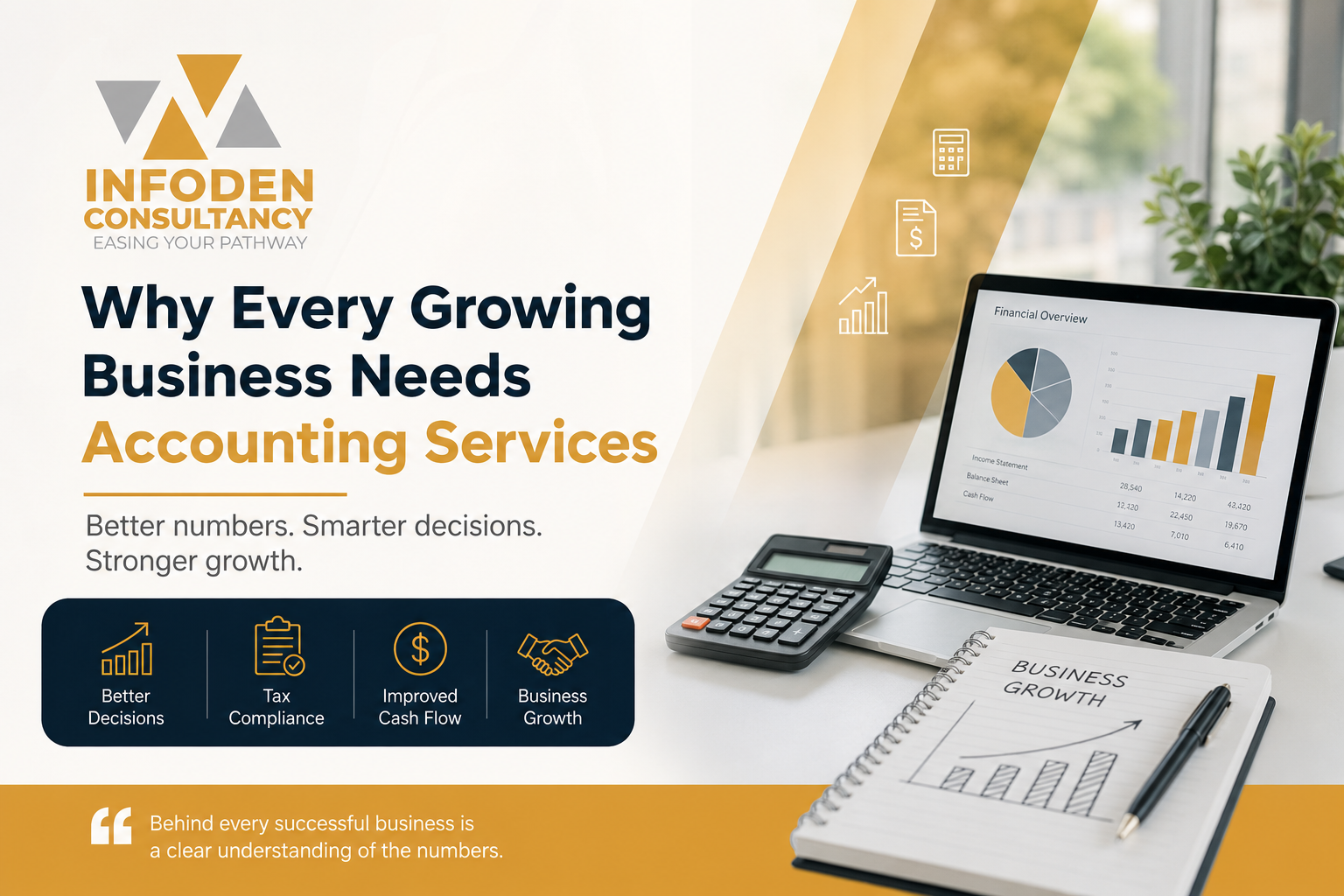
Why Every Growing Business Needs Professional Accounting Services
Many people think accounting simply means recording income and expenses. That's bookkeeping...
Many people think accounting simply means recording income and expenses.
That's bookkeeping.
Accounting goes much further.
Professional accounting helps business owners understand:
Where money is going
Which products or services are profitable
Whether the business can afford expansion
How much tax should be paid
How much cash is actually available
Whether the business is financially healthy
Think of accounting as the dashboard of your business.
You wouldn't drive a vehicle hundreds of kilometres without checking the fuel gauge, engine temperature or speedometer.
Running a business without proper accounting is much the same.
How Accounting Services Support Business Growth
Growing a business means making decisions every week.
Should you hire another employee?
Should you buy new equipment?
Can you afford another branch?
Should you increase prices?
Without reliable financial information, these decisions become educated guesses.
Professional accountants replace guesswork with facts.
Better Cash Flow Management
Many profitable businesses fail because they run out of cash.
Cash flow and profit are not the same thing.
Imagine you've completed a project worth US$30,000.
Your customer will pay after 90 days.
Meanwhile, salaries, rent, taxes and suppliers all require payment this month.
On paper, you're profitable.
In reality, you're struggling to pay today's bills.
Professional accounting helps monitor incoming and outgoing cash so these situations don't become crises.
Smarter Business Decisions
Successful businesses rarely make important decisions based on instinct alone.
They rely on financial reports.
These reports reveal:
Best-performing products
Poor-performing departments
Rising costs
Seasonal trends
Customer profitability
Growth opportunities
Instead of asking,
"How do I feel about the business?"
You begin asking,
"What do the numbers tell me?"
That shift changes everything.
Accurate Budgeting
Businesses often overspend because they don't have realistic budgets.
A good accounting system allows you to:
Forecast future income
Plan expenses
Allocate resources wisely
Avoid unnecessary debt
Budgeting also gives investors and lenders confidence that your business is managed responsibly.
Easier Tax Compliance
Tax compliance is often stressful for business owners who only think about taxes when deadlines arrive.
Professional accountants help ensure:
Taxes are calculated correctly
Returns are submitted on time
Supporting records are maintained
Penalties are avoided
Opportunities for legitimate tax savings are identified
In Zimbabwe, remaining compliant with ZIMRA requirements is especially important because tax compliance often affects your ability to:
Obtain Tax Clearance Certificates
Participate in tenders
Secure funding
Maintain a good business reputation
Stronger Business Credibility
Banks, investors, procurement authorities and potential partners often request financial statements.
Professionally prepared financial records show that your business is organised and trustworthy.
Poor financial records can delay:
Loan applications
Investment opportunities
Government tenders
Business partnerships
Many opportunities are lost simply because businesses cannot produce reliable financial information.
Easier Access to Funding
Investors don't invest based on optimism.
Banks don't approve loans based on enthusiasm.
They rely on numbers.
Professional accounting helps prepare:
Income statements
Balance sheets
Cash flow statements
Financial forecasts
Budgets
Management accounts
These documents demonstrate that your business understands its financial position and future potential.
Why Small Businesses Need Accounting Even More
A common misconception is that accounting only becomes important once a business becomes large.
The opposite is usually true.
Small businesses operate with limited cash reserves.
One expensive mistake can seriously affect operations.
Professional accounting helps small businesses:
Price products correctly
Separate personal and business finances
Understand profitability
Plan for taxes
Manage growth sustainably
Starting with proper financial systems is far easier than trying to fix years of poor record keeping later.
Accounting Helps You Understand Profitability
Revenue tells you how much money comes in.
Profit tells you what remains.
These are very different.
Suppose two businesses each generate US$500,000 in annual sales.
Business A earns US$150,000 profit.
Business B earns US$15,000.
Without proper accounting, both businesses appear equally successful.
Financial reporting reveals the truth.
Knowing where profit comes from allows business owners to improve pricing, reduce unnecessary costs and focus on high-performing products or services.
Business Growth Creates Financial Complexity
Growth brings exciting opportunities.
It also creates new financial challenges.
As businesses expand, they often deal with:
More employees
Payroll administration
VAT
Multiple suppliers
Larger inventories
Credit customers
Financing arrangements
Additional tax obligations
Managing these manually becomes increasingly risky.
Professional accounting systems grow alongside the business.
Accounting Supports Strategic Planning
Imagine planning to open a second branch.
Without accounting information, important questions remain unanswered.
Can the business afford expansion?
How long before the investment pays for itself?
Will cash flow remain healthy?
Should expansion be financed through profits or borrowing?
Accounting provides the data needed to answer these questions confidently.
Technology Has Changed Modern Accounting
Accounting today isn't just calculators and spreadsheets.
Modern cloud-based accounting systems provide:
Real-time financial reports
Digital invoicing
Expense tracking
Bank reconciliation
Payroll integration
Secure document storage
Financial dashboards
This means business owners can monitor performance much more quickly than in the past.
The right technology, combined with professional oversight, improves accuracy and saves valuable time.
Common Mistakes People Make
1. Waiting Until Tax Season
Many businesses only organise their finances when tax deadlines approach.
This creates unnecessary stress and increases the risk of errors and penalties.
Avoid it: Maintain financial records throughout the year.
2. Mixing Personal and Business Money
Using one bank account for everything makes accurate reporting difficult.
It also creates confusion during tax preparation.
Avoid it: Open separate business accounts and maintain proper records.
3. Ignoring Cash Flow
Businesses sometimes focus only on sales.
Sales don't guarantee available cash.
Avoid it: Monitor cash flow every month.
4. Making Decisions Without Financial Reports
Guesswork often leads to poor pricing, unnecessary spending and unrealistic expansion.
Avoid it: Review financial statements before making major decisions.
5. Trying to Do Everything Alone
Many entrepreneurs become overwhelmed handling sales, operations, marketing, customer service and accounting simultaneously.
Eventually something gets neglected.
Avoid it: Seek professional support before problems become expensive.
Expert Perspective
Businesses that grow consistently tend to have one thing in common: they understand their numbers.
Financial discipline isn't about satisfying accountants or tax authorities.
It's about giving business owners clarity.
Across Zimbabwe and many other markets, lenders, investors and procurement organisations increasingly expect businesses to maintain proper financial records. Regulatory requirements continue to evolve, making timely compliance more important than ever.
Businesses that invest early in sound accounting systems are usually better positioned to scale, attract finance and respond confidently to changing market conditions.
Accounting is no longer a back-office function. It is a strategic management tool.
Frequently Asked Questions
1. Why are accounting services important for businesses?
Accounting services help businesses monitor financial performance, manage cash flow, comply with tax laws and make informed decisions that support long-term growth.
2. Can small businesses manage without accountants?
Some can initially, but professional accounting becomes increasingly valuable as the business grows and financial obligations become more complex.
3. What's the difference between bookkeeping and accounting?
Bookkeeping records financial transactions.
Accounting analyses those records, prepares reports and provides financial advice for decision-making.
4. How often should businesses review their financial reports?
Most businesses should review key reports monthly, with more frequent monitoring of cash flow where appropriate.
5. Do accounting services help reduce taxes?
Professional accountants help businesses comply with tax laws while identifying legitimate deductions and planning opportunities permitted under applicable legislation.
6. Can accounting services improve profitability?
Yes. Better financial information helps businesses identify unnecessary costs, improve pricing and focus on profitable activities.
7. When should a startup hire an accountant?
Ideally from the beginning. Establishing proper systems early prevents costly mistakes later.
8. What financial reports should every business understand?
Every business owner should understand:
Income Statement
Balance Sheet
Cash Flow Statement
Budget
Accounts Receivable
Accounts Payable
9. Can accountants help businesses obtain funding?
Yes. Lenders and investors often require professionally prepared financial information before considering funding applications.
10. Why is cash flow more important than profit?
Profit measures long-term financial performance.
Cash flow determines whether the business can meet today's financial obligations.
A profitable business can still fail if cash runs out.
11. How do accounting services support tax compliance in Zimbabwe?
Professional accountants assist with accurate record-keeping, tax registrations, VAT compliance, return preparation, and ongoing compliance with ZIMRA requirements, helping businesses avoid unnecessary penalties.
12. Should I outsource accounting or hire an in-house accountant?
It depends on your size and needs. Many small and medium-sized businesses benefit from outsourcing because they gain access to professional expertise without the full cost of employing a dedicated finance team.
Action Checklist
Use this checklist to strengthen your business's financial management:
☐ Separate personal and business finances.
☐ Maintain accurate bookkeeping throughout the year.
☐ Review monthly financial reports.
☐ Monitor cash flow regularly.
☐ Prepare an annual business budget.
☐ Keep supporting documents for all transactions.
☐ Submit tax returns on time.
☐ Review profitability by product or service.
☐ Plan financially before expanding.
☐ Consult a qualified accounting professional when making significant financial decisions.
Conclusion
Business growth isn't measured by how busy you are.
It's measured by sustainable profits, healthy cash flow, informed decisions and financial stability.
Professional accounting services provide the information needed to build all four.
Whether you're launching a startup, expanding an established company or preparing for investment, reliable financial management helps you move with confidence rather than uncertainty.
Businesses that understand their numbers are better equipped to manage risk, seize opportunities and build lasting success.
How Infoden Consultancy Can Help
At Infoden Consultancy, we believe accounting should do more than produce reports—it should give business owners the confidence to make better decisions.
Our team supports businesses with accounting services, tax registration, ZIMRA compliance, VAT registration, Tax Clearance Certificates, business planning, funding readiness, strategic business consultancy, and ongoing compliance support.
If you're looking to strengthen your financial management, improve compliance, or prepare your business for its next stage of growth, we'd be happy to help you build a solid financial foundation.
Frequently Asked Questions
1. Why are accounting services important for businesses?
Accounting services help businesses monitor financial performance, manage cash flow, comply with tax laws and make informed decisions that support long-term growth.
2. Can small businesses manage without accountants?
Some can initially, but professional accounting becomes increasingly valuable as the business grows and financial obligations become more complex.
3. What's the difference between bookkeeping and accounting?
Bookkeeping records financial transactions.
4. How often should businesses review their financial reports?
Most businesses should review key reports monthly, with more frequent monitoring of cash flow where appropriate.
5. Do accounting services help reduce taxes?
Professional accountants help businesses comply with tax laws while identifying legitimate deductions and planning opportunities permitted under applicable legislation.