What Are QPDs, and When Are They Due?
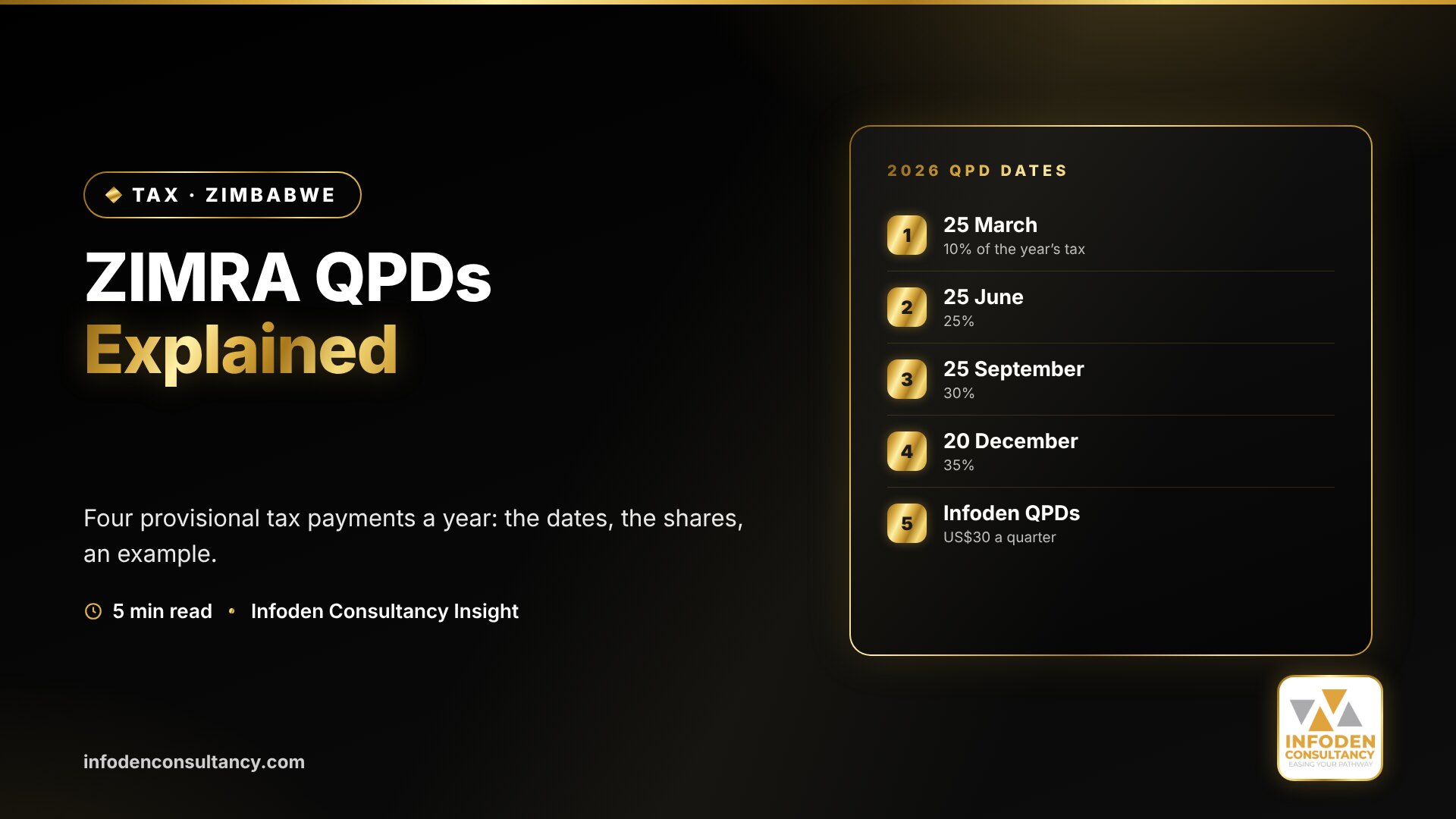
QPDs are four provisional income tax payments: 10% by 25 March, 25% by 25 June, 30% by 25 September, 35% by 20 December. How they work, with an example.
Short answer
QPDs (quarterly payment dates) are four instalments of provisional income tax that businesses pay during the year on the tax they expect to owe: 10% by 25 March, 25% by 25 June, 30% by 25 September and 35% by 20 December, with a return (ITF12B) for each. Infoden works out and files your QPDs for US$30 a quarter.
Most people think income tax is paid once a year, after the accounts are done. In Zimbabwe, a business pays most of it before the year even ends, in four slices called QPDs.
Miss one, and your tax clearance is at risk. Get the estimate badly wrong, and penalties follow. Here is how it works.
| Key fact | Answer |
|---|---|
| What it is | Provisional income tax, paid in four instalments during the year |
| Who pays | Companies and others with income outside the PAYE (final deduction) system |
| Return | ITF12B, the provisional tax return, before each payment |
| Dates (31 December year-end) | 25 March, 25 June, 25 September, 20 December |
| Shares of the year’s estimated tax | 10%, 25%, 30%, 35% (together 100%) |
| Infoden | US$30 a quarter, all fees included |
What exactly is a QPD?
A QPD is an advance payment of income tax. At the start of the year you estimate your taxable income for the whole year and the tax on it. You then pay that tax in four parts on fixed dates, instead of one large bill after the year ends.
Think of it like paying school fees by the term instead of all at once in December.
When are the QPDs due, and how much is each?
For a business with a 31 December year-end, ZIMRA set these dates for 2026:
| QPD | Return (ITF12B) by | Payment by | Share of the year’s estimated tax |
|---|---|---|---|
| 1st | 20 March | 25 March | 10% |
| 2nd | 20 June | 25 June | 25% |
| 3rd | As set in ZIMRA’s notice | 25 September | 30% |
| 4th | 15 December | 20 December | 35% |
ZIMRA confirms each QPD in a public notice shortly before it falls due. Businesses with a different year-end approved by ZIMRA follow the dates approved for them.
How is a QPD worked out?
Take a company that expects taxable profit for 2027 that leads to US$20,000 of income tax.
| QPD | Share | Amount |
|---|---|---|
| 1st, by 25 March | 10% | US$2,000 |
| 2nd, by 25 June | 25% | US$5,000 |
| 3rd, by 25 September | 30% | US$6,000 |
| 4th, by 20 December | 35% | US$7,000 |
| Total | 100% | US$20,000 |
When the annual return (ITF12C) is filed by 30 April the next year, the real tax is compared with what was paid. Any shortfall is paid then; an overpayment is credited.
The estimate isn’t fixed. ZIMRA expects it to be reviewed and updated every quarter as the year unfolds, for example after winning or losing a big contract.
Which currency do I pay QPDs in?
For 2026, ZIMRA’s rule is: if more than 50% of your estimated income is in foreign currency, you work out tax separately on the foreign and local currency parts (the 50:50 basis). If 50% or less is in foreign currency, you account in the currency you trade in.
Who has to pay QPDs?
- Companies and PBCs with taxable income.
- Sole traders, consultants and other self-employed people.
- Professionals and transport operators who moved from presumptive tax to self-assessment, such as architects, engineers, legal and health practitioners, estate agents, and operators of larger buses and goods vehicles (ZIMRA public notices for 2026).
- Employees with other income, such as rent or a side business. Income taxed fully under PAYE isn’t part of it.
Why do QPDs matter for my tax clearance?
A missed QPD return or payment shows up as outstanding on your ZIMRA account, and an outstanding item stops ZIMRA issuing your tax clearance certificate (ITF263). Without a clearance, your clients must withhold 30% of what they pay you. See our tax clearance guide.
Common mistakes
- Paying but not filing the ITF12B. Both the return and the payment are required.
- Guessing low on purpose. A big gap between the estimate and the real tax invites penalties and interest.
- Never updating the estimate. A year that turns out much better or worse than planned should change the later QPDs.
- Treating VAT as income tax. VAT and QPDs are separate taxes with separate returns.
- Forgetting the weekend. When a due date falls on a weekend, pay on the working day before.
Frequently asked questions
Does a new company have to pay QPDs?
Yes, if it expects taxable income for the year. A company that expects a loss in its first year estimates nil tax, but it should still review the estimate each quarter.
What if I overpay my QPDs?
The overpayment is set against the year’s final tax when your annual return is assessed. Anything left is dealt with through ZIMRA’s refund or offset process, which Infoden handles for clients.
Can I change my QPD estimate during the year?
Yes. ZIMRA expects the estimate to be revised every quarter. A revised estimate changes how much is due at the next QPD, so the year still adds up to 100%.
How much does Infoden charge for QPDs?
US$30 a quarter, all fees included. We work out the estimate with you, file the ITF12B and tell you exactly what to pay before each date.
What to do next
Write the four QPD dates into your calendar now, and set aside money for each one from your monthly income.
Or let Infoden do it: we file your QPDs for US$30 a quarter and keep your tax clearance safe. See our tax services.
Never miss a QPD
US$30 a quarter, all fees included. We estimate, file and remind you.
Sources and law
- ZIMRA Public Notices 17 of 2025, 36 of 2026 and 58 of 2026 (2026 QPD dates, shares, 50:50 basis, operators moved from presumptive tax); Public Notice 20 of 2026 (ITF12C due 30 April). Checked 24 November 2026.
- ZIMRA: New businesses (provisional tax, ITF12B, quarterly revision of the estimate). Checked 24 November 2026.
- ZIMRA: Tax payment dates. Checked 24 November 2026.
- Income Tax Act [Chapter 23:06], section 37A (self-assessment).
This is general information, not legal or tax advice for your specific situation. Contact Infoden for advice on your situation.