I’m Hiring My First Employee. What Must I Register For?
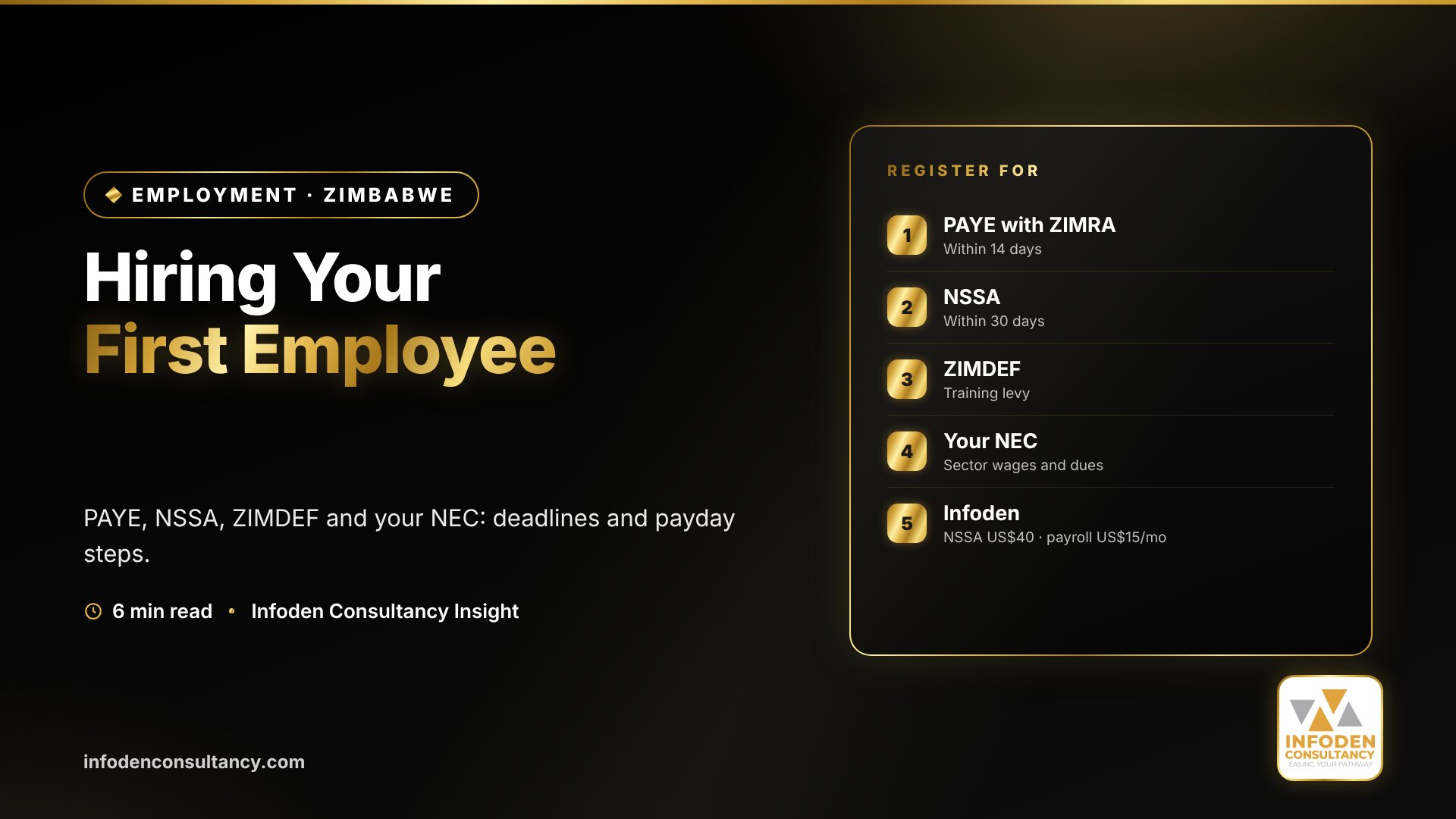
First employee in Zimbabwe? PAYE with ZIMRA within 14 days, NSSA within 30 days, ZIMDEF and your NEC. What to do on payday, with an example.
Short answer
When you hire your first employee in Zimbabwe, you must register with ZIMRA for PAYE within 14 days and with NSSA within 30 days, and usually with ZIMDEF and your industry’s National Employment Council (NEC). Each month you then file PAYE by the 5th, and pay it and NSSA by the 10th. Infoden registers you (NSSA US$40, ZIMRA US$60) and runs payroll from US$15 a month.
Your first hire is a big moment. It is also the moment the government starts expecting monthly returns from you, and the deadlines start before the first payday.
Here is everything a new employer must register for, what each one costs you per month, and what to do every payday.
| Registration | Deadline | Then every month |
|---|---|---|
| ZIMRA, PAYE | Within 14 days of becoming an employer | Return by the 5th, payment by the 10th |
| NSSA | Within 30 days of becoming an employer | P4 return and contributions by the 10th |
| ZIMDEF | Registration is compulsory for employers | Levy on the gross wage bill |
| Your industry’s NEC | If your sector has a National Employment Council | NEC dues; follow the sector’s minimum wages and conditions |
Which registrations do I need when I hire my first employee?
1. PAYE with ZIMRA, within 14 days
ZIMRA says every person who becomes an employer must register within 14 days. PAYE (pay as you earn) is the income tax you deduct from salaries using ZIMRA’s tax tables and pay over each month. At the end of the year you also file the ITF16, a summary of each employee’s pay and tax, within 30 days.
2. NSSA, within 30 days
Every employer must register with NSSA, the National Social Security Authority, within 30 days of becoming an employer. You deduct 4.5% from each employee’s basic pay and add 4.5% yourself, on earnings up to US$700 a month, plus a workers’ compensation premium that you alone pay. See our NSSA employer guide.
3. ZIMDEF
ZIMDEF, the Zimbabwe Manpower Development Fund, collects a training levy from employers under section 53 of the Manpower Planning and Development Act [Chapter 28:02]. ZIMDEF says registration is compulsory and that failing to register is a criminal offence. The levy is a percentage of your gross wage bill, paid by the employer, not deducted from staff.
4. Your industry’s National Employment Council (NEC)
Most sectors, such as commercial, construction, transport, catering and agriculture, have a National Employment Council set up under the Labour Act [Chapter 28:01]. Its collective bargaining agreement sets the minimum wages, grades and working conditions every employer in that sector must follow, and the council collects monthly dues. Which NEC applies depends on what your business does.
What happens on payday?
- Work out gross pay, including allowances.
- Deduct NSSA (4.5% of basic pay, up to the ceiling). It comes off before PAYE is calculated.
- Work out PAYE from ZIMRA’s tax tables, plus the AIDS levy on the tax.
- Deduct any NEC dues your sector requires.
- Pay the employee the net pay and give them a payslip.
- By the 5th of next month: file the PAYE return. By the 10th: pay PAYE to ZIMRA and file and pay NSSA.
Example: one employee on US$500 a month
| Amount | |
|---|---|
| Basic pay | US$500.00 |
| Employee NSSA (4.5%) | US$22.50 deducted |
| Employer NSSA (4.5%) | US$22.50 paid by you |
| PAYE | Worked out from ZIMRA’s tables on pay after NSSA |
| Also from you | Workers’ compensation premium, ZIMDEF levy, NEC dues where they apply |
The cost of an employee is more than the salary. Budget for the employer’s NSSA, workers’ compensation and the levies before agreeing a wage.
What else should a new employer have in place?
- A written contract setting out pay, hours, duties, leave and notice, in line with your NEC’s agreement.
- Payroll records for every employee, kept for at least six years for ZIMRA and available to NSSA inspectors.
- A code of conduct, so discipline follows a fair procedure.
Common mistakes
- Paying cash with no PAYE or NSSA. Arrears, penalties and interest build up, and NSSA arrears penalties can’t be passed to employees.
- Paying below the NEC minimum. An inspector can order back pay for every month underpaid.
- Missing the 14-day PAYE registration. An unregistered tax head also blocks your tax clearance.
- Treating casual workers as outside the rules. Casuals who work regularly are covered by NSSA, and every worker is covered for workplace injury.
Frequently asked questions
Do I need to register for PAYE if I pay my only employee in cash?
Yes. How you pay doesn’t matter. Once you employ anyone, you must register with ZIMRA for PAYE within 14 days and with NSSA within 30 days.
How do I know which NEC my business belongs to?
It depends on your main business activity. Infoden checks which council covers your sector and what its agreement requires.
How much does Infoden charge to set up a new employer?
NSSA registration is US$40 and ZIMRA tax registration, including PAYE, is US$60 in 2–3 days, all fees included. Monthly payroll, PAYE and NSSA filing starts at US$15 a month for under 5 employees.
Do directors count as employees?
A director paid a salary under an employment contract is treated like any other employee for PAYE and NSSA. Directors’ fees and dividends are taxed differently, so contact Infoden about your setup.
What to do next
Before your first payday, contact Infoden with the employee’s details and start date.
We register you with ZIMRA (US$60) and NSSA (US$40), tell you which NEC applies, and can run your payroll from US$15 a month. See our NSSA registration service.
Hiring your first employee?
ZIMRA US$60, NSSA US$40, payroll from US$15 a month. All fees included.
Sources and law
- ZIMRA: New businesses (employers register within 14 days; PAYE; ITF16; six-year records). Checked 24 November 2026.
- ZIMRA Public Notice 61 of 2026 (PAYE return by the 5th, payment by the 10th). Checked 24 November 2026.
- NSSA: Registrations and Contributions. Checked 24 November 2026.
- ZIMDEF FAQs (levy under section 53 of the Manpower Planning and Development Act [Chapter 28:02]; registration compulsory).
- Lucent Consultancy: NEC compliance. Checked 24 November 2026.
- Labour Act [Chapter 28:01].
This is general information, not legal or tax advice for your specific situation. Contact Infoden for advice on your situation.